
One for the Money Two for the Road – Page 2 of 15 – Ultimate Road Trip Experiences
Featured 
We’re not sure there are enough pretty words in the English language to describe Canyon de Chelly (pronounced Canyon d’Shay). However, stunning, beautiful, and breathtaking immediately come to mind. As a national monument and also part of the Navajo Nation, its history is just as inspiring as its beauty. Enjoy the journey. 
Where is it?
Canyon de Chelly is near Chinle, Arizona, which is located in the northeastern corner of the state.
- Admission to the national monument is free.
- Tours of the canyon floor require fees and are not booked through the park. Click here for a list of approved tour operators.
- Call the Navajo Parks and Recreation Department at 928-674-2106 for campground and backcountry camping information.
Access the national monument’s website here.

Rain, Rain Go Away
We arrived at Canyon de Chelly with a reservation at the Thunderbird Lodge, a tour that had been booked through said lodge, and an 82% chance of rain. If it rained, we weren’t sure the tour would go on. It was too early to check in to our room, so we made ourselves a picnic lunch and ate on the patio in front of the office under darkening skies.
 Thunderbird Lodge. We loved this hotel!
As luck would have it, it started raining about five minutes before our tour was to depart. Our guide, Fernando, insisted that the tour was a go, so we boarded an interesting open top vehicle for what was sure to be a rain-soaked adventure.
 Fernando and the truck. Thunderbird Lodge guides conduct their tours in Pinzgauer troop transport vehicles that were built in Austria in the 1970s.
Fortunately, the heavens smiled down on us, and the rain stopped as soon as we grabbed our complimentary bottled water and snack from the office. Off we went, along with five other people, into a (normally) dry wash that had turned into a river along the canyon floor.
 Thankfully the water wasn’t deep, but Fernando said in 40 years of living and working in the canyon he hadn’t seen so much water in the wash. Not knowing the difference, we thought the watery wash just added to the adventure.
Canyon de Chelly – The Floor
Access to the canyon floor is only permitted with a Navajo guide or a park ranger. (There is one self-guided trail that leads to a small portion of the canyon floor, but it was closed when we were there.) Besides Thunderbird Lodge, which we highly recommend, there are several other tour companies with various tour packages. Ours was a four-hour tour and we thought it was perfect for viewing the spectacular scenery and learning the canyon’s history.
 This shot shows a great example of desert varnish: the drippy striations on the canyon walls where minerals have leached out and stained the rock.
Canyon de Chelly is still occupied by Navajo families who have farmed and raised livestock there for generations, though today most of them only live in the canyon seasonally.
 Mostly made up of De Chelly sandstone, the canyon walls vary in height from 30 feet to 1,000 feet. All of them are spectacular.
Things Best Seen from the Canyon Floor
The National Park Service maintains a scenic drive with overlooks along the rim of the canyon. However, here is what visitors will miss by not touring the floor: closer looks at Ancestral Puebloan cliff dwellings! Our tour took us to seven ruins, and each one was mind boggling, especially because some of them are located so high above the canyon floor. We’ve highlighted a few of them below.
 First Ruin – that’s really the name.
There are approximately 2,500 ancient dwellings in Canyon de Chelly and adjoining Canyon de Muerto. Built between 1500 BC and 1350 AD, the dwellings have survived because they’re under overhangs or in cave-like formations in the rock.
 Junction Ruin, so named because it is near the junction of Canyon de Chelly and Canyon de Muerto.
  Ledge Ruin because it’s on a ledge, and that ledge is in a natural amphitheater.
  Antelope House was built on the ground and was once covered in white plaster.
We saved our favorite, White House Ruin, for last. Building began at this site around 1050 AD. Over the next two centuries, more rooms were added resulting in 80 rooms and four kivas at its height. White House was originally covered in white plaster.
 White House Ruin and its rock art.
Ancient Rock Art
Canyon de Chelly’s amazing rock art cannot be seen from the rims. Yet another reason a tour of the canyon floor should be included on every itinerary. Below are a few of the many pictographs and petroglyphs that we saw on our tour.
Pictographs (painted on the rock)
 Antelope or deer, people – perhaps a family, and a hill or rainbow.
  Cow, antelope, horses, flowing water, and perhaps an astrological symbol.
  This spectacular pictograph panel depicts the arrival of Spanish explorers, including a priest.
Petroglyphs (chiseled into the rock)
 This probably depicts a deer hunt on horseback.
  Horses, maybe and and a figure eight which possibly has an astrological meaning.
  Possible depictions of snakes and other unknown images.
Canyon de Chelly – The Rim
There are three overlooks along North Rim Drive and six overlooks along South Rim Drive. Allow a few hours to enjoy all of the overlooks when visiting the park.
 Recent rains filled the wash and enhanced the “green”.
  Views from the top are just as stunning as they are from the floor.
  Spider Rock (center) is probably the most recognizable feature of Canyon de Chelly and rises 1,000 feet from the canyon floor.
Tragic Navajo History
Our post would not be complete without mentioning the 1863 – 1864 attacks led by Col. Kit Carson on the Navajo people who lived in and around Canyon de Chelly. In an effort to open up the western part of the country for settlement, the government decided the way to control Native Americans was to move them to encampments.
 Traditional Navajo hogan (dwelling – pronounced hoe-gone) in Canyon de Chelly.
However, the Navajo, after hearing about the raid, fled to the top of a butte called Fortress Rock.
 Fortress Rock – a sacred place for today’s Navajo people.
The people watched from atop Fortress Rock while Carson and his men destroyed their homes and orchards, killed their sheep, and stole their horses. Once captured, the Navajo were deemed prisoners of war and forced to walk 300 miles to Fort Sumner, New Mexico – a journey that is now known as the Long Walk.
 This shot shows a ladder (the two wooden poles on the right) used by the Navajo people who fled to the top of Fortress Rock.
Many Navajo people died during the Long Walk. Those who survived the trek were confined in a prison camp called Bosque Redondo. Living conditions at Bosque Redondo were horrific, and many people died of disease and malnourishment while imprisoned there. The hardships continued for four long years until a treaty was signed. Finally, the people were allowed to return to their homelands.
Thank you so much for joining us on our tour of Canyon de Chelly! Our closing shot is of a rainstorm at sunset.
 Canyon de Chelly
For more national monument inspiration, check out these other great destinations:
Safe travels, y’all!
Mike and Kellye

As always, we strive to be as accurate with our information as possible. If we made a mistake, it was unintentional. (Hey, we’re only human!) Our suggestions are for places that we’ve heard good things about but haven’t visited personally, and our opinions are our own.
©2023
Featured 
Welcome to a place where the only trees in sight are petrified! We first visited Petrified Forest National Park in 2008. At the time we were in a hurry to reach another destination and unfortunately did not make the most of our visit. This time we made the most of our visit by walking most of the trails, learning more, and hopefully making better photographs. We hope you enjoy touring the park with us. 
Where is it?
Petrified Forest National Park is located between I-40 and Highway 180, near Holbrook, Arizona. Access the park’s website here.
 The Painted Desert Inn, which is a National Historic Landmark, can be found on the portion of Historic Route 66 that traverses the park. The former inn now serves as a museum.
What you should know before you go:
- Admission fees apply.
- The 28-mile-long park road is open from 8:00 am to 5:00 pm, as are the Rainbow Forest and Painted Desert Visitor Centers.
- The Painted Desert Inn National Historic Landmark is open from 9:00 am to 4:00 pm.
- A park film can be viewed in either of the two visitor centers.

- There are parking areas, trails, and/or overlooks at all the main attractions in the park.
- Pets are allowed in the park as long as they are leashed. Horses are allowed in designated wilderness areas.
- A diner and convenience store with gasoline are located next to the Painted Desert Visitor Center. There are also several picnic areas with restrooms throughout the park.

- There are no campgrounds in the park. However, backcountry camping is allowed in designated wilderness areas of park, and a permit is required.
- Park sponsored demonstrations, guided activities, and workshops take place throughout the year.
 It’s hard to believe this was once a rainforest and riparian ecosystem.
Rainbow Forest Museum
Our first stop was at the Rainbow Forest Museum and visitor center where we learned about the prehistoric history of the park. Once part of the super continent called Pangea about 220 million years ago, what is now Petrified Forest National Park was about 10 degrees north of the equator.  As a rainforest surrounded by rivers and swamplands, its inhabitants included intriguing pre-dinosaur age animals that roamed or swam in the area.
 Placerias hesternus lived before and then with the dinosaurs.
Displays in the museum featured several interesting animals including the placerias hesternus. According to museum information: Placerias hesternus (plu-SAYR-ee-us hess- TERN-us) was a dicynodont therapsid. Therapsids were large “reptiles” that possessed many mammalian characteristics including a “cheek” bone, enlarged canine teeth, and a specialized attachment of the skull to the spine. This massive plant-eater was up to 9 feet (2.7 m) long and might have weighed as much as two tons.
 Artist’s rendition of what the animal might have looked like.
Interestingly, a large number of placerias hesternus fossils were found in a quarry in St. Johns, Arizona, a town southeast of the park.
Giant Logs Trail
Giant Logs Trail located behind the Rainbow Forest Visitor Center lives up to its name. Below are a few photos of the colorful petrified tree trunks along the trail. 


Crystal Forest
Believe it or not, the logs in Crystal Forest had become crystalline quartz before T. rex arrived 135 million years later!
 Crystal Forest
According to the park, this area was once on the edge of a river channel. Flooding over time caused the trees to become buried under silt which preserved them. Gradually the volcanic silica in the groundwater replaced the molecules in the wood and created a replica of the tree or log in quartz.
 Littered with logs.
  Spectacular colors.
Blue Mesa
The Blue Mesa area of the park was probably the most intriguing to us because of the incredible geology. We didn’t caption the photos below because words really can’t describe the beauty of the place. 

 According to the park: The colorful bands of the Chinle Formation represent ancient soil horizons. While the red, blue, and green layers generally contain the same amount of iron and manganese, differences in color depend on the position of the groundwater table when the ancient soils were formed. In soils where the water table was high, a reducing environment existed due to a lack of oxygen in the sediments, giving the iron minerals in the soil a greenish or bluish hue, such as at Blue Mesa. The pink and reddish layers were formed where the water table fluctuated, allowing the iron mineral to oxidize (rust).
 That’s a little bit of snow in the left foreground.
The Tepees
Blue Mesa isn’t the only area of the park with breathtaking terrain. Introducing the Tepees.
 The Tepees
According to the park: The Tepees are located in the middle of the park, but expose one of the lowest, thus oldest, rock members within the park and the Painted Desert.
 View across the road from The Tepees. Oh, those colors, and we accidentally captured the moon!
Newspaper Rock
Newspaper Rock is not just one rock. Throughout the area are many rocks with petroglyphs and other writings. Visitors view the rocks through telescopes/binoculars at the viewpoint – or in our case by zooming in with the camera. Most of the rock below is covered with petroglyphs that are thought to date back 600 – 2,000 years.
 Petroglyphs
Puerco Pueblo
Petrified Forest National Park protects the ruins of a village that was once a 100-room pueblo and home to about 200 people. Puerco Pueblo’s residents were farmers who grew beans, corn, and squash while utilizing the nearby Puerco River for irrigation. Scientists believe the site was abandoned by 1380 due to climate change and severe drought conditions.
 Some of the pueblo ruins.
  One of several kivas (underground ceremonial rooms) located on the site.
Painted Desert
Named by Spanish explorer Francisco Vasquez de Coronado, the Painted Desert actually stretches about 150 miles from the eastern side of the Grand Canyon southeast to Petrified Forest National Park. Visitors traveling the portion of Historic Route 66 through Petrified Forest can see even more of the park’s breathtaking landscapes from several viewpoints along the way. Gorgeous desert vistas can also be seen from the Painted Desert Visitor Center.
 Stunning vista.
  Pretty in pink.
While we have barely scratched the surface of Petrified Forest National Park, we hope we have inspired some wanderlust. This is one of those parks that cannot be justified by photographs and words; it needs to be seen in person to be appreciated for its beauty and historic importance. We thank you so much for joining us on our road trip!  Need more national park inspiration? Try these other great parks:
Happy, safe travels, y’all!
Mike and Kellye
As always, we strive to be as accurate with our information as possible. If we made a mistake, it was unintentional. (Hey, we’re only human!) Our suggestions are for places that we’ve heard good things about but haven’t visited personally, and our opinions are our own.
©2023
Featured 
Oh, how we love to visit New Mexico. It truly is The Land of Enchantment! We are enchanted by all of New Mexico, but we are particularly fond of the northern half of the state with its gorgeous mountains, breathtaking landscapes, and intriguing Native American culture.

Adding to the enchantment, New Mexico has 15 national park units, three national historic trails, and seven national scenic byways! Since it’s impossible to stop for photos at every turn we decided to share a glimpse of what we’ve seen through the windshield on our road trips through the state. Please accept our apologies for the occasional blurs, bugs, and other imperfections. Enjoy the ride.
Northwest: The Four Corners Area
 Mountains and wildflowers on US 160 near Four Corners Monument in the far northwest corner of the state.
Four Corners Monument is a Navajo park where the corners of the states of New Mexico, Colorado, Utah, and Arizona meet. Apart from our home state of Texas, those happen to be our four favorite states.
 Here we are in all four states at once (kind of). Though not taken through the windshield, obviously, we had to stand in line to get our turn, and the people behind us were kind enough to take our picture.
  Otherworldly landscape near Shiprock.
  Ghostly Shiprock in a haze.
Shiprock is located on Navajo land about 15 miles southwest of the town of Shiprock. It is a 1,583-foot volcanic plug that is sacred to the Navajo people who believe the rock looks like a bird. According to legend, a big bird carried their ancestors to the top of the rock in order for them to settle in the area. The name Shiprock was coined by explorers in the 1800s who thought it looked like a ship.
 Gorgeous Navajo landscape as seen from the highway near Chaco Culture National Historical Park.
  Heading south on Highway 550.
North Central: Closest to Santa Fe
 Highway 442 near Taos

 Highway 96 near Abiquiu Lake northwest of the town of Abiquiu (Abba-cue).
  Near Los Alamos – Jemez Mountain Trail National Scenic Byway (click for website).
  Another gorgeous Jemez Mountains view. (It’s not a video – that’s a road sign.)
  On the Turquoise Trail National Scenic Byway (click for website) near the small town of Cerillos.
  From Highway 14 – Sangre de Cristo Mountains near Santa Fe.
West Central: Closest to Albuquerque
 Highway 117 about 20 miles south of I-40 near Grants
  Highway 53 between El Morrow National Monument and Ramah
  On Highway 55 north of Mountainair, New Mexico
East Central: The Middle of Nowhere
 Desolation. Highway 60 between Clovis and Fort Sumner.
South Central: Closest to Roswell
 Sierra Blanca peak near Ruidoso. Featured photo. Sacramento Mountains off of Highway 54.
  Free range cattle near Carlsbad.
Southwestern: Closest to Las Cruces
The following views were from I-10 between Las Cruces and Lordsburg.


Are you enchanted yet?
Thank you so much for joining us on our journey! We hope that we’ve given you a glimpse into the beautiful and diverse landscapes of New Mexico through our windshield. Our closing shot is from the north central area of the state. 
If you’re looking for additional road trip inspiration, try these ideas:
Safe travels, y’all!
Mike and Kellye

As always, we strive to be as accurate with our information as possible. If we made a mistake, it was unintentional. (Hey, we’re only human!) Our opinions are our own.
©2023
Featured 
We were so excited to see the lower cliff dwelling at Tonto National Monument that we checked out of our hotel early and hit the road for the 30-minute drive to the park. While we had high expectations of the park, we didn’t know how scenic the drive would be. As we drove through mountains and saguaro forests, a lake came into view. What a surprise! Tonto National Monument overlooks the stunningly beautiful Roosevelt Lake. We got a double dose of spectacular scenery when we least expected it!
 Imagine topping a hill and seeing an unexpected first glimpse of a beautiful lake surrounded by mountains!
Farther down the road a left turn took us to Tonto National Monument, and due to our excitement, we arrived before the visitor center opened. However, that wasn’t a problem because we had lots of fresh air and plenty of breathtaking scenery to enjoy from the parking lot while we waited.
 Scenic Roosevelt Lake and snowcapped mountains as seen from the visitor center parking lot. Little did we know that we would be driving through those snowy mountains later that day.
Where is Tonto National Monument?
Tonto National Monument is located in the Tonto Basin area of the Tonto National Forest in the far northeast corner of the Sonoran Desert. The physical address is 26260 N. Arizona Highway 188, Roosevelt, Arizona.
The park features include:
- Visitor Center and bookstore
- Museum
- Park film
- Self-guided tour of the lower dwelling
- Guided tours are required for the upper dwelling – check with the park for information.
- Entry fee
Click here to access the park’s website.
 Lower dwelling
Why is Tonto National Monument significant?
Tonto National Monument protects the ruins of two ancient cliff dwellings that were built around 1300 CE. The cliff dwellers who occupied these sites are referred to informally as Salado people, a name which was given by archaeologists simply because they built their homes overlooking the Salt River, now Roosevelt Lake. Salado people were hunters, gatherers, and farmers, so the valley along the Salt River provided an excellent area in which to grow crops.

Archaeologists have found remains of macaws from Mexico or Central America, which indicates that the Salado were traders. Their woven cotton items and beautiful pottery would have made excellent products for trade. The cliff dwellers abandoned the site between 1400 and 1450 CE, but no one knows why they left or where they went.
 Depiction of what the lower dwelling might have looked like when it was inhabited.
Interestingly, nobody knows where the name Tonto came from, though popular belief is that it came from the Tonto Apache who lived in the area, but nobody knows why they were called Tonto. President Theodore Roosevelt signed a proclamation to create Tonto National Monument in 1907, five years before Arizona became a state. Then in 1966, the site was added to the National Register of Historic Places.
Lower Cliff Dwelling
The walls of the cliff dwellings were built of stone and mud, unlike the structures at nearby Casa Grande Ruins which were made of clay-like caliche. Archaeologists theorize that several families may have occupied the 20 rooms of the lower dwelling. Each of the rooms has a fire pit or hearth which backs up the theory. Smoke residue on the cave’s ceiling can still be seen today.

Many of the walls and even a couple of ceilings remain intact. Below are some additional shots of from inside the dwelling.
 Stone and mud wall
  Another view of the same wall as above
  Remains an upper level of the structure with the cave wall
  The pine or juniper beams would have supported a roof or a ceiling.
Originally, the dwelling’s roof beams were covered with saguaro spines then topped with mud, and the cave’s floors were leveled with dirt then covered over and smoothed with clay.
 Interesting geology. Not only pretty, but practical.
The caves at Tonto National Monument lie in a geologic layer called Dripping Springs Quartzite. While the caves made ideal places to build their dwellings, the rock, primarily quartz and feldspar, was utilized by the Salado to make implements and weapons.
 Detail of the rock layers at Tonto National Monument.
The Museum
Tonto National Monument’s Museum should be a priority for anyone visiting the park. We learned a lot while browsing the exhibits, however, it was the pottery we were most interested in. It’s incredible that these delicate ollas, pots, and bowls survived unprotected for hundreds of years! 


With such brilliant colors occurring in their natural surroundings, it’s no wonder that the Salado and other Ancient Sonoran Desert People used them in their pottery. For an interesting article about the region’s pottery, click here.
Visiting Tonto National Monument
We recommend starting out with the museum and park film for an overview of what lies high up in the caves and the people who lived in them. Ideally, the second order of business would be to hike to the lower dwelling. The paved trail is .7 miles out and back and has a 362-foot elevation gain. Hiking websites claim it is a moderately challenging trail, however, we did it with just a couple of stops and some heavy breathing. That said, if we can do it, most everyone else can do it. There are even some benches along the way for those who want to sit and catch their breath. By the time we cooled down while browsing the museum, our visit to the park had lasted about three hours.
Lower dwelling as seen from the trail.  View of the trail looking back toward the visitor center parking lot.
  And the views from the top are worth all the panting to get there!
Upper Cliff Dwelling
Those who want to visit the upper dwelling can do so on a reserved guided tour. Therefore, we recommend calling the park or visiting the website for reservation information before planning a trip to Tonto National Monument. Reservations usually open on October 1 and fill up quickly. Considered moderately challenging, the unpaved trail to the upper dwelling is 2.4 miles out and back with a 646-foot elevation gain. Allow three to four hours for this hike.
 National Park Service photo of the Upper Dwelling.
Our closing photo is another view of scenic Roosevelt Lake.  Thank you for letting us share Tonto National Monument with you! We are truly honored to have you join us on our road trips. If you’re looking for more road trip inspiration, check these out:
Happy, safe travels, y’all!
Mike and Kellye
As always, we strive to be as accurate with our information as possible. If we made a mistake, it was unintentional. (Hey, we’re only human!) Our opinions are our own.
©2023
Featured 
Saguaro (pronounced suh-war-o) National Park is a landscape unlike any other we’ve seen. A literal cactus forest divided into two units – the Rincon Mountain District (east) and the Tucson Mountain District (west) – and it is approximately 30 miles between the two.  We visited the east unit on a day when a cold front was blowing in and it was very windy. On the next day when we visited the west unit, we woke up to snow which thankfully disappeared quickly as the day warmed up. Both units were great, but if we had to choose only one, we would probably choose the west unit.
 View of the Rincon Mountains from the east unit.
We are excited to share this park with you and hope you enjoy learning about it through our words and lenses.
Where is it?
Saguaro National Park is located in the Sonoran Desert near Tucson, Arizona. The east unit is located at 3693 S. Old Spanish Trail, Tucson, Arizona. The west unit is located at 2700 N. Kinney Road, Tucson, Arizona.
 Along Cactus Forest Drive (scenic drive) at the east unit.
The park features:
- Visitor centers at each unit with exhibits, park films, and cactus gardens
- Bookstores at each unit’s visitor center
- Hiking trails at each unit
- Bicycling trails at each unit
- Horseback riding allowed on trails at the east unit
- Backcountry camping with permit
- Picnic areas at each unit
- Scenic drives at each unit
- Ranger-led programs
- Entry fee covers both units
Access the park’s website here.
 The two saguaros in the center look like they’re high fiving each other. This view is from the Bajada Loop Drive (scenic drive) at the west unit.
The Sonoran Desert
 Map credit: Cephas, Wikimedia Commons.
Spanning 120,000 square miles, the Sonoran Desert covers parts of Arizona and California as well as parts of Mexico. Neighbors include the Chihuahuan Desert to the East, the Mojave Desert to the north, and the Great Basin Desert to the northwest, with each desert possessing different distinguishing factors and its own diverse ecosystems.

The Sonoran Desert’s subtropical climate is characterized by its mild winters and hot summers. It is the hottest desert in North America. Rainfall varies from 3-16 inches per year, though some higher elevation areas receive more rain along with snow in the winter. The desert’s monsoon season usually runs from July through September.
 Saguaros only grow in the Sonoran Desert.
This desert is home to over 2,000 species of plants. Organ pipe cactus is another species that only grows in the Sonoran Desert and can be found at Organ Pipe Cactus National Monument in the southwest corner of Arizona.
Desert Cacti
While the saguaros are the stars of the show at Saguaro National Park, we enjoyed learning about some of the other cactus varieties that make their home in the Sonoran Desert.
 Teddy bear cholla
Our newest cactus discovery was the teddy bear cholla (pronounced choy-uh). We have a lot a cholla around where we live, but not this species. Even though the teddy bear cholla looks soft and cuddly, it is not!
 Fishhook barrel cactus
If we had visited the park in September rather than in March, we probably would have seen the fishhook barrel cactus in bloom. The interesting thing about this cactus is that it leans toward its greatest source of light. By doing this, the larger plants can topple over and uproot themselves.
 Chain fruit cholla
We never knew that there were so many species of cholla. We also saw staghorn cholla and pencil cholla. The one above is called a chain fruit cholla because it produces grapelike clusters of edible fruit. It is sometimes known as the jumping cholla due to its short, jointed stems that can easily drop from the plant and attach to people or animals that may be passing by.
Desert Trees
 Palo verde tree
Palo Verde means green stick in Spanish. Identifiable by their green bark, these interesting trees are found throughout the Sonoran Desert. Three things that make this tree so unique:
- It only has leaves/blooms during the spring, dropping them as temperatures climb in order to prevent water loss.
- It lives on virtually no water for prolonged periods of time.
- It survives by photosynthesis through its bark.
 Creosote bush
We were first introduced to creosote bushes at Big Bend National Park, and it’s likely that we only paid attention to them then because they smell so good – especially after a rain. Nevertheless, the unique thing about creosote bushes in the Sonoran Desert is that they, along with palo verde trees, mesquite trees, and other cacti species, are nurse plants for the saguaro. That means that baby saguaros grow underneath these nurse plants using their shade and nutrients to help the saguaro mature. As the saguaro grows, it takes all of the nurse plant’s nutrients and water which eventually kills the nurse.
The Saguaro
 Perfect saguaro?
While we walked trails and drove through Saguaro National Park, we spent a lot of time looking for a perfect saguaro. The fact is, there are few that epitomize what we thought a saguaro should look like. First of all, many of them have holes where desert dwelling birds have built homes. (But with no trees, what’s a bird to do?) Secondly, some saguaros have been affected by cold weather or old age, and they’re just not pretty anymore – at least they didn’t look pretty to us. Fortunately, we found a few perfect ones to share.  Here are some interesting facts about saguaros:
- Without knowing when it was planted there is no way to tell the age of a saguaro.
- Saguaros grow about one inch in its first 5 – 10 years.
- A saguaro may reach 6 feet tall by the time it is 35 – 60 years old and will flower for the first time around 55 years old.
- At 50 – 75 years old the saguaro will start to grow arms and may reach a height of 8 – 20 feet tall.
- While they are considered mature at 125 years old, saguaros can live between 150 – 200 years, and some may live up to 250 years.
- Pleats on the body of the saguaro allow them to expand to retain water, and the number of pleats matches number of wooden ribs on the inside of the plant.
- A fully grown saguaro can weigh up to 4 tons.
- Saguaros bloom for only 24 hours then the blossoms grow into fruit which is edible.
- Saguaro blossoms are the state flower of Arizona.
 Snow tipped saguaros – west unit.
Crested Saguaros
 Rare crested saguaro
Crested, or cristate, saguaros are rare, and while some biologists believe that the crests are caused by genetic or hormonal reasons, others think there is a physical cause, such as a lightning strike or cold snap, for the fan-like formations. The fact is that nobody really knows for sure what causes the mutations. When we found out about them, we added them to our mission to find a perfect one, but the one pictured was the only one we found in either unit. According to a ranger, only 25 crested saguaros have been found among the 2 million saguaros living in the park.  The Crested Saguaro Society has catalogued about 3,300 of these unusual cacti throughout the Sonoran Desert region. Information about their finds is kept in a secret database so that vandals and poachers cannot locate the unique specimens.
It’s Not All About Cactus
Arizona and its surrounding states have been home to indigenous people for thousands of years. Clues to their existence have been left behind in cliff dwellings and other archaeological sites, implements, pottery, and rock art. Rock art can be painted (pictographs) or carved into the rock (petroglyphs). Saguaro National Park has a fine collection of about 200 petroglyphs at a site called Signal Hill.
 Some of Signal Hill’s petroglyphs
Hohokam (pronounced hoho-kahm) people, who lived in the area between 450 AD and 1450 AD created Saguaro National Park’s petroglyphs. How do we know this? Some of the same designs are seen in their pottery. Nobody really knows what the symbols mean, though there are speculations.


According to park information, some researchers believe that the petroglyphs are religious symbols. Others believe they may commemorate an event, mark a solstice, or even tell a story. We like to think that the ancient people were recording what they saw – similar to today’s photographs. Regardless of what they mean, it is fun to view them and try to make our own interpretations.
We are going to close the post with a few more shots from around the park.
 East unit trail view of pretty saguaros and other plants.
  West unit view from Signal Hill.
  Even though it was technically still winter, we saw wildflowers. Desert marigold, perhaps? Unfortunately, we missed a desert super bloom by about two weeks.
Thank you so much for exploring Saguaro National Park with us! If you love national parks or need more road trip ideas, check out these other great parks:
Grand Canyon National Park
Guadalupe Mountains National Park
Rocky Mountain National Park
Happy, safe travels, y’all!
Mike and Kellye
As always, we strive to be as accurate with our information as possible. If we made a mistake, it was unintentional. (Hey, we’re only human!) Our suggestions are for places that we’ve heard good things about but haven’t visited personally, and our opinions are our own.
©2023
Featured
Casa Grande might have been a family home, or it could have been a trade center. Perhaps it was a religious complex or an astrological observatory. The truth is that nobody knows, but a trip to this intriguing national park site will leave visitors with an admiration for the ingenuity of the Ancient Sonoran Desert People as well as a lot to wonder about.

Where is it?
Casa Grande Ruins National Monument is located at 1100 W. Ruins Drive in Coolidge, Arizona, which is about a 1-hour drive from either Phoenix or Tucson. The park features:
- Visitor center
- Museum
- Introductory film
- Self-guided tours of the site
- Periodic guided tours – check with the park for dates and times
- Covered picnic tables
- Free admission
Access the park’s website here.
 Casa Grande
Why is Casa Grande Significant?
Occupied from 450 AD to 1450 AD, Casa Grande is part of what was once a community of Hohokam (pronounced: hoho-kahm) people near the Gila River in south-central Arizona. In fact, archaeologists have found evidence of several similar communities in the area, though none have a structure like Casa Grande. Considered one of the largest prehistoric structures in North America, Casa Grande was built sometime between 1300 AD and 1350 AD. The site’s first recorded history comes from the journals of Jesuit priest Father Eusebio Kino, who arrived in 1694 and gave the Great House its name. Although, by that time the site had been abandoned for almost 250 years.

The people who lived in the Casa Grande community were farmers who grew gourds, corn, beans, tobacco, and cotton. Interestingly, an elaborate system of irrigation canals provided water for the crops and the people. The park also features a mound that is believed to have been a sports arena or some type of ball field used for the same type of games that are known to have been played by the Aztec people of Mexico. These unique sports fields have also been found in other area villages. Since the people who lived at Casa Grande left no evidence of a written language, little is known about them or where they went when they left the site.
 Wooden beams and iron bars were used to stabilize the walls of the structure when the first repair efforts began in the 1890s.
The Great House
Casa Grande is built of caliche (kuh-leechee) which is a hard clay like substance made up of mud, sand and calcium carbonate and is found underneath the topsoil in dry areas such as the Sonoran Desert. Dry caliche can be as hard as concrete which is probably why the structure has survived for so many centuries.
 Perhaps the Ancient Sonoran Desert People dug up the caliche while digging their irrigation canals, and then carried it to the construction site in baskets.
 Detail of the caliche.
The Community
 Other remains of the Casa Grande village.
Archaeological evidence suggests that in addition to farming, Casa Grande’s people also made pottery, implements, and arrowheads. Archaeologists also know that the Hohokam people were traders. Known trade items include small copper bells, parrots, and crop seed that came from Mexico. Shells from California, which were used to make jewelry, have also been found. As cotton farmers, the residents of the Casa Grande community were also weavers. Woven cotton items likely would have been a prime commodity for trade.
 Undated historical photo showing the village.
The park’s visitor center has a wonderful museum with exhibits showing some of the pottery and implements found at Casa Grande. Between 1860 and 1880, the village was on a stagecoach route originating from a railway station about 20 miles away. Unfortunately, stage passengers who stopped at the site not only vandalized the structures, but they also collected souvenirs and scratched graffiti into the walls. We can only imagine how many priceless artifacts were pilfered before the government stepped in to protect the site.
National Park Service photo of a stagecoach at Casa Grande circa 1888-1889.
Establishment of a Park
Archaeologists and anthropologists who visited Casa Grande in the late 1800s urged the government to repair and protect the site’s structures. Their convincing worked, and in 1889, congress voted to protect the site from further vandalism and erosion and began some repairs such as the rods and beams we mentioned previously.
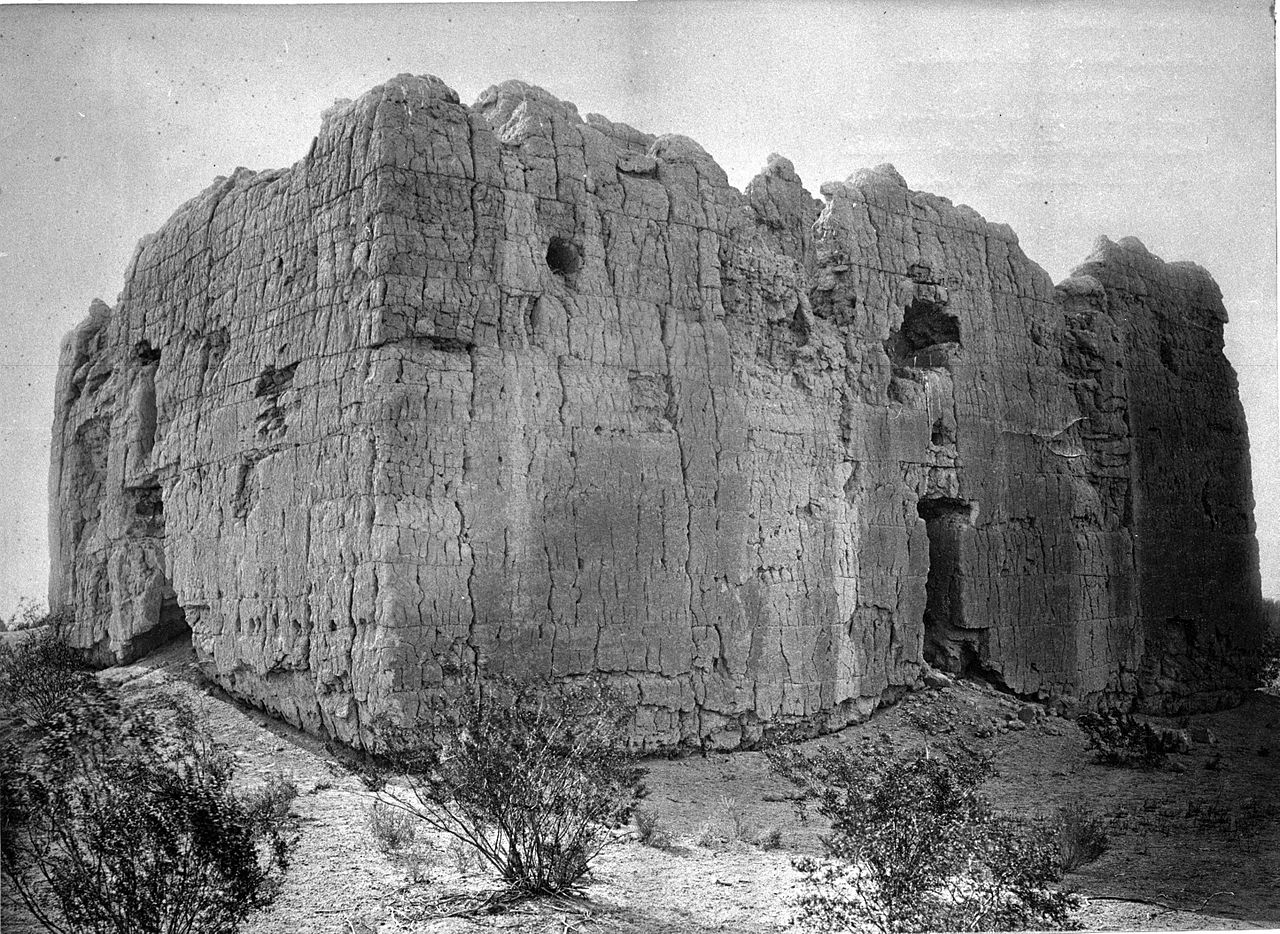 West wall of Casa Grande, 1880. National Forest Service photo.
Three years later, President Benjamin Harrison set aside one square mile of land surrounding the Great House as the first federally protected prehistoric and cultural preserve in the U.S. and called it Casa Grande Reservation.
 West wall of Casa Grande, 2023.
President Woodrow Wilson designated Casa Grande Ruins as a national monument in 1918. An electrical powerplant, the visitor center, paved park road, and paved parking lot, as well as a new steel shelter for the Great House were all completed in 1932.
 Casa Grande’s 1932 steel shelter is still in great condition today.
We were fortunate to have been able to join a ranger talk during our visit to the park. One of the most fascinating parts of the presentation was the history of the steel shelter. Designed by renowned architect Frederick Law Olmstead, Jr., the structure can withstand hurricane force winds and allows airflow around the structure while not obstructing visibility of the ruins. Its four slanted legs are actually drainpipes that allow water from the roof drain into underground pipes and away from the Great House. Now, that’s ingenious!
We will close the post with one more historic photo of the Great House, courtesy of the National Forest Service.
 Casa Grande circa 1900.
Thank you for taking the time to visit Casa Grande Ruins National Monument with us!
While you’re here, you might want to check out these other great national monuments:
Fort Union National Monument
Devils Tower Road Trip: Things to Do
Craters of the Moon National Monument
Safe travels, y’all!
Mike and Kellye
As always, we strive to be as accurate with our information as possible. If we made a mistake, it was unintentional. (Hey, we’re only human!) Our suggestions are for places that we’ve heard good things about but haven’t visited personally, and our opinions are our own.
©2023
Featured 
We have visited a lot of beautiful missions as well as ruins of missions, but none of them compared to San Xavier del Bac (pronounced: san ha-vee-air dell bock). Known as the White Dove of the Desert, San Xavier is located on the Tohono O’odham (pronounced ah-dum, similar to autumn) San Xavier Indian Reservation. Today San Xavier maintains its original purpose as a parish church and school and is a National Historic Landmark.
 San Xavier del Bac
Where is it?
The mission is located at 1950 San Xavier Road, Tucson, Arizona in the village of Wa:k, which is part of the Tohono O’odham Reservation. The site features:
- Mission church
- Gift shop
- Museum (currently closed)
- Guided and self-guided tours
- Grotto Hill – adjacent to the church
- Free admission
Click here for a short essay about San Xavier’s history.
 Grotto Hill, which is not part of the mission, sits adjacent to the church and features a replica of the grotto at Lourdes.
San Xavier del Bac Mission
Jesuit priest Father Eusebio Kino, who was the founder of twenty-four missions in the southwestern US, Mexico, and Baja California, founded San Xavier in 1692. In 1783, the Franciscan mission priest Fr. Juan Bautista Velderrain obtained a loan from a Sonoran rancher to build the church we see today. Spanish architect Ignacio Gaona utilized O’odham workers for the actual labor. Construction materials include fired brick, lime mortar, and masonry vaults for the roof. The church was completed in 1797 and is considered one of the most outstanding examples of Spanish Colonial architecture in the US.
 This is an undated photo of San Xavier del Bac. Note the residences that surround the church. Photo credit: Library of Congress.
Throughout the years, San Xavier has undergone many repairs and restorations beginning with an earthquake in 1887 that collapsed one of the mortuary chapel walls and damaged the church. Additional restorations have been done periodically when the mission has had the funds to do them, and conservation efforts continue today. Even so, we don’t think the building has changed much according to the old photos.
 Circa 1887 – probably after the earthquake damaged the mortuary chapel and church. Photo credit: Library of Congress.
Trivia: Wa:k means Bac in the O’odham language. Bac means where the water comes from beneath the sand.
The Church
 San Xavier del Bac altar
Unfortunately, the stunning sanctuary was undergoing repairs during our visit and was full of scaffolding, so we only got a few good pictures. There were also worshipers in the church at the time, and we didn’t want to disturb them. Nevertheless, we were drawn to the elaborate altar with its colorful details and beautifully carved santos portraying Catholic saints. Scalloped shell motifs can be seen inside and outside the church and were used to honor the pilgrimages of Santiago, also known as Saint James the Greater, the patron saint of Spain.
 The Last Supper mural on the wall of the sanctuary. The walls of the sanctuary feature many frescoes.
  Apse frescoes and windows.
The Mortuary Chapel
 Mortuary Chapel
We have seen mortuary chapels at other missions. They are used similarly to a funeral home where people go to mourn the dead before burial. San Xavier’s mortuary chapel is a place for people to light candles. A lighted candle is a prayer offering, a symbol of one’s devotion to Jesus, Mary, or one of the saints.
 A glimpse inside the mortuary chapel.
  From the courtyard between the church and the mortuary chapel.
The Facade
San Xavier’s facade is certainly attention grabbing because it welcomes visitors directly into the church. Although, if we had not followed along with a volunteer tour guide, we wouldn’t have noticed the interesting details.  Details of the facade include depictions of the crops that the O’odham people grew, such as squash, grapes, watermelons, wheat, beans and corn. These plants are easily seen in the top section. Also in the top section are male and female lions. Note that they do not look like African lions, but they look like the puma or mountain lions that the O’odham people would have been familiar with. Interestingly, the lions are said to represent the king and queen of Spain because Arizona was still part of Spain when San Xavier was built. Perhaps the most intriguing parts of the top portion are the curlicues on either side of the facade.
 Top and middle sections of the facade
Look closely at the tops of the curlicues. On the left-hand side is a mouse and on the right-hand side is a cat. The belief is that if the cat ever catches the mouse, it will be the end of the world. A large scallop shell sits prominently between the statues of two saints, while two additional saints are featured on the bottom section. Some of the original paint can still be seen on the saints and on some of the embellishments.
 Detail of Santa Barbara. Note the original paint colors on her clothes and the embellishments.
We found the Baroque details, especially the curtains, quite interesting because those wouldn’t have been seen anywhere in the area at that time. Of course, architect Ignacio Gaona would have seen these adornments throughout Spain or other parts of Europe and most likely brought the ideas to San Xavier.
Unfinished Business
Even after two centuries and several renovations, portions of San Xavier are still unfinished. For example, the east tower doesn’t have a dome to match the west tower. The east tower has gone through recent structural repairs, however, causing its new paint to appear stark against the rest of the building.

There are several theories about the unfinished church that give pause for thought. One theory, and probably the most likely, is that the church ran out of money. Another a popular belief is that construction was halted after a worker fell to his death from the east tower. Further theories suggest that an unfinished building wouldn’t be taxed. Perhaps no one will ever know why the church has remained unfinished for so long, but we believe it is perfect just the way it is.
 Sanctuary ceiling – unfinished details.
Miscellany
The historic photo below shows the Tumacacori santos in San Xavier’s baptistry.
 Tumacacori santos
When the residents of Tumacacori left in 1848, they took the santos from their church to their new home at San Xavier. Today the santos are back home in the museum at Tumacacori National Historical Park. One of Tumacacori’s santos, however, does remain at San Xavier and is sometimes mistaken by visitors as a mummy. Originally the saint was a carved depiction of the crucified Christ, though now encased in glass, the reclining figure has been redesignated as Saint Frances Xavier who was the first Jesuit missionary. The statue remains in the west transept of the church.
We are closing the post with one last shot of the church’s west tower.

Thank you for joining us on our trip to San Xavier del Bac!
Looking for more road trip inspiration? Check out these other amazing destinations:
San Antonio Missions
Catoctin Mountain Park and National Shrine Grotto
Antietam National Battlefield
Safe travels, y’all!
Mike and Kellye
Altar photo credit: Geremia, Wikimedia Commons. Apse photo credit: Nicholas Hartmann, Wikimedia Commons.
As always, we strive to be as accurate with our information as possible. If we made a mistake, it was unintentional. (Hey, we’re only human!) Our suggestions are for places that we’ve heard good things about but haven’t visited personally, and our opinions are our own.
©2023
Featured 

Where is Tumacacori National Historical Park?
Tumacacori (pronounced tooma-cockery) is located in Tumacacori, Arizona. The park site is approximately 50 miles south of Tucson and 20 miles north of the Mexican border town of Nogales on Interstate 19.
 Tumacacori’s visitor center has our vote for one of the prettiest visitor centers we’ve seen, and it is a designated National Historic Landmark.
The park features:
- Visitor center with gift shop and bookstore
- Park film
- Guided tours – check with the park for times
- Self-guided tours
- Ruins of two additional mission sites – available for 4-hour guided tours only
- Hiking
- Picnic tables
- Special events and demonstrations – check with the park for times and dates
- Museum
- Admission fees apply for entry
Access the park’s website here.
 Visitor center courtyard and garden, constructed in 1939.
Why is Tumacacori significant?
As with all of the southwestern US missions, Tumacacori’s lands were once the home of Native American people. Southern Arizona was the homeland of the O’odham (pronounced ah-dum, similar to autumn) who were hunters, gatherers, and farmers. Padre Eusebio Kimo, a Jesuit priest, founded the first area mission in 1691 along the Santa Cruz River south of the current park site. He named the new mission San Cayatano de Tumacacori. Shortly thereafter, Padre Kimo founded a second mission, San Angeles de Guevavi, about 15 miles upriver from the first Tumacacori. Another Jesuit priest founded the area’s third mission, San Cayatano de Calabazas. Tumacacori National Historical Park protects the ruins of the three missions and is located on the Juan Bautista de Anza National Historic Trail. 
San Jose de Tumacacori Church
In 1751, more than 100 people, including two priests, were killed when O’odham rebels staged a rebellion. The fear of additional raids caused many of the mission’s residents to leave. Therefore, in order to make a better home for the mission’s residents, Padre Kimo’s first Arizona mission was relocated to what is now the park site and renamed San Jose de Tumacacori.
 Mission San Jose de Tumacacori church
Mission San Jose Tumacacori’s second church was never fully completed, although it was dedicated in 1822 and used until Tumacacori was abandoned in 1848.
 Ruins include the footings of the original Jesuit church and part of the convento (the priests’ living quarters).
 In 1767, the Spanish governor ordered all Jesuit priests out of his domains and into exile. He then sent Franciscan priests to replace them. Therefore, it was under the direction of Franciscan priest Fray Gutierrez that construction began on Tumacacori’s three-story church in 1800.
 A view of the nave from the front doors.
Still partially covered in their original lime plaster, the thick adobe walls continue to stand strong. A baptistry was to the right of the front doors, and above it on the second story was the choir preparation room. The choir loft was once above the front doors, and the sacristy (priest’s office) was to the right of the sanctuary. Worshipers stood or knelt during mass as there were no pews in the church.
 The sanctuary.
Shadows of picture frames and other embellishments that once adorned the church are still visible. Some original paint and stenciling can still be seen as well.
 East view showing the church’s white dome and the white barrel-vaulted ceiling of the sacristy.
The Bell Tower
 Scalloped niches were used to hold statues of saints.
Tumacacori church’s three-story bell tower begins at ground level with the baptistry, the second level choir preparation room, and the third level arched tower. Originally each arch held a bell, and the bells were rung several times a day for various reasons. Nobody knows what happened to the original bells, but they were likely taken by vandals and melted down for other uses. Constructed of fired bricks, the tower was to have originally been covered in white plaster, but that was never done. It is uncertain whether the tower was to have had a white dome to match the church. Interestingly, the adobe walls of the baptistry and choir preparation room are nine feet thick in order to hold the weight of the bell tower.
San Jose de Tumacacori Cemetery
 Most missions had a church cemetery, and Tumacacori was no different. White walls surrounded the little cemetery which is located behind the church. Nooks that would have held the 14 Stations of the Cross are still visible in the thick wall. There are some graves in the Tumacacori cemetery, although none of them are original to the functioning mission. Sadly, the cemetery’s original graves were desecrated by vandals and grave robbers after the mission was abandoned. Then adding insult to injury, the cemetery was used for a time as a cattle corral.
 Mortuary chapel
The round building above sits in the middle of the cemetery and is the unfinished mortuary chapel, which when completed was to have had a white domed roof. Mortuary chapels were used to hold vigils for the dead before they were buried.
 This view shows the mortuary chapel with the church in the background.
Years later, people in the surrounding community began burying their dead in the cemetery. The last burial, an infant, took place in 1916.
The Museum
Set up in time-line style, the outstanding museum covers the history of the area beginning in prehistoric times and continues through the abandonment of Tumacacori. The museum features, artifacts, dioramas, exhibits, and art, all depicting life around and at Tumacacori.
 This display shows how the O’odham people lived before the Spanish missionaries arrived.
The priests that administered the area missions kept immaculate records of marriages, births, deaths, baptisms, and other pertinent information about the people who lived there. Today the park has a free online database of the records for anyone who wants to search them by family name. Learn more about the database, Mission 2000, here.
 Handwritten records were kept by the priests.
  A depiction of farming at the mission.
Residents of Tumacacori grew squash, corn, beans and other crops. Orchards were also planted, and crops were irrigated using a water diversion system called an acequia.  The six wooden santos (saints) that once stood in Tumacacori’s church now reside behind glass in the park’s museum. We apologize for the glare.
Melhok Ki
 Melhok ki
This melhok ki, which means ocotillo house in the O’odham language, is an example of a traditional O’odham dwelling. Melhok ki walls and roofs were constructed using the cane-like branches of the ocotillo. Sometimes mesquite branches and other woody plants found in the desert were used as well. Then once the framework was complete, the structure would be covered in mud inside and out. Some of the mission residents would have lived in traditional homes like this one while others lived in more modern adobe dwellings near the church.

Goodbye Tumacacori
 This artist’s depiction shows what Tumacacori might have looked like with the completed church.
With the hardships of the Mexican-American war, increasing Apache raids, and harsh weather conditions, the last residents took their santos and left Tumacacori in 1848. Their destination was another mission that was located about 25 miles to the northwest. Sadly, the church and other buildings of Tumacacori fell victim to vandals and into disrepair. Then after 60 years of deterioration, President Theodore Roosevelt protected the site by establishing Tumacacori National Monument in 1908. When the site was redesignated as a National Historical Park in 1990, the Calabazas and Guevavi ruins came under the park’s care.

Thank you for joining us at Tumacacori!
You might also enjoy these other national park sites:
Pecos National Historical Park
New Castle, Delaware and First State National Historical Park
Marsh-Billings-Rockefeller National Historical Park
Safe travels, y’all!
Mike and Kellye
As always, we strive to be as accurate with our information as possible. If we made a mistake, it was unintentional. (Hey, we’re only human!) Our suggestions are for places that we’ve heard good things about but haven’t visited personally, and our opinions are our own.
©2023
Featured 
 Middle of nowhere?
While driving to Bisbee, we found ourselves out in the middle of nowhere again. Well, a middle of nowhere that afforded us a view of the most spectacular rainbow cloud and a cute javelina that was nosing around on the side of the road – definitely our kind of place! We were also surrounded by mountains, some just distant silhouettes as the sun began to sink behind them. Then, as the chill of dusk settled over us, we found ourselves in Bisbee, queen of the copper camps.

As if the surrounding mineral rich, copper-colored hills weren’t enough, indications that Bisbee was an old mining town were all around us. The skeletal remains of a concentrator that once processed millions of tons of ore kept a lonely vigil along the side of the road. A headframe (a mine elevator, of sorts) across the road stood watch over a once bustling mine. We couldn’t wait to dig into Bisbee, but sightseeing would have to wait until the next day.
Where is Bisbee?
Bisbee is 12 miles north of the border with Mexico, off of Highway 80 in the southeastern corner of Arizona. The closest large city is Tucson which is 97 miles northwest.
 Arizona map courtesy of GIS Geography.
Click here for an interesting short history of Bisbee.
The Inn at Castle Rock
Our hotel, The Inn at Castle Rock, was our first stop when we arrived in Bisbee. We knew very little about the hotel but booked it because they had one room available for a reasonable price and their ratings were decent.
 The Inn at Castle Rock, Bisbee
Upon check in, the desk clerk gave us a quick tour and then showed us to our room called “Crying Shame”. While the inn wasn’t our usual type of accommodation, it had some great qualities such as a wonderful owner and staff, a free help-yourself-to-whatever’s-there breakfast, and it was clean. Built in 1877, it turns out that the inn has quite a history. They even claim to have a ghost or two lurking around but, disappointingly, we didn’t encounter any. Read a short history and see a few old photos of The Inn at Castle Rock here.
 Our funky “Paris” themed room was nothing fancy, but it was comfortable and clean.
  The historic spring fed well in the inn’s lobby – once the main water source for the original town of Bisbee.
At night, the inn shines the Bat Signal on Castle Rock which is across the street. Did we mention that the inn is kind of funky? We’ve stayed in historic hotels before, but this one has to be the most offbeat. For anyone looking for a totally out of the ordinary place to stay, we would recommend it.
 Holy holograms Batman it’s the Bat Signal on Castle Rock!
With our luggage dropped off in the room, we were ready to eat, so it was off to downtown Bisbee to seek sustenance.
A Quiet Evening in Bisbee
 Downtown Bisbee, 8:30 pm. Not much happening here.
We arrived at the restaurant that had been recommended by the inn, and that’s where it was happening, at least on that evening. The restaurant, Bisbee’s Table, which is located in the old mercantile building and shares its space with a bookstore and a bodega, must be a popular place for travelers and locals alike.

We had a short wait before the hostess led us to our table. Once we were served our tasty food, we could see why the place was so busy. Then it was back to the inn for some sleep so we could be up and at ’em early for a morning of sightseeing.
 Outside Bisbee’s Table
After a good night’s sleep and a breakfast of oatmeal, bagels, and bananas, we were ready to do some exploring. Our first stop was the Lavender Pit.
The Big Hole
Bisbee’s “big hole” consists of three open pit mines that were once owned and operated by the Phelps Dodge Corporation. They are the Lavender Mine, the Sacramento Hill Mine, and the Holbrook Mine. Another Phelps Dodge operation was the Queen Mine which sits adjacent to the Lavender Pit and at one time was the highest producing copper mine in Arizona. The historic Queen Mine, Bisbee’s main tourist attraction, can be toured today by those who don’t mind venturing underground into a mine shaft. Unfortunately, we didn’t have time to take the tour, so maybe another trip to Bisbee will end up on our agenda at some point.
 Lavender Pit
The city of Bisbee has created a nice scenic overlook area at the Lavender Pit. We spent about 45 minutes there, taking pictures and viewing the “big hole”. Mining began at the Lavender Pit in 1950 and continued until the mine was closed in 1974. The pit is 4,000 feet wide, 5,000 feet long, 850 feet deep and covers 300 acres. It produced over 600,000 tons of copper during its 24 years in operation.
 Headframe on the edge of the Lavender Pit. Headframes are elevators that lowered men and equipment into mine shafts.
Other byproducts of the Lavender Pit included Bisbee Blue turquoise, azurite, and malachite. We would love to get our hands on some of these…um, gems.
 This display in the Bisbee Mining and Historical Museum shows the different minerals found in the local mines. Azurite is the azure blue, the dark green is the malachite, and the turquoise is…well, turquoise.
And speaking of the Bisbee Mining and Historical Museum, that was our next stop.
Bisbee’s Smithsonian Affiliate Museum
 Bisbee Mining and Historical Museum sits right in the middle of town and is a “shouldn’t miss” for any visitor. Covering the history of Bisbee and its mining heritage, the museum appropriately occupies the building that once housed the Phelps Dodge Corporation’s general offices. The building was designated a National Historic Landmark in 1983. While we photographed a lot of the museum’s displays, it was the historic photos that grabbed our attention the most.
 Bisbee’s Brewery Gulch, early 1900s.
 The scenes above and below reflect a very different Bisbee than what we see today. Of course, mining was the top priority in Bisbee, so civic responsibilities and city beautification wasn’t really on anybody’s mind until the early 1900s.
Bisbee on the rise
While mine workers came to Bisbee from all over the world beginning in the early 1880s, men with families began arriving in the early 1900s. The city was incorporated in 1902, and it was then that the town began taking on a modern city feel. Public sanitation, clean water, and fire protection were highly important to the newly incorporated city, so work to implement those necessary services began. During that time, suburbs also began springing up. One suburb, Warren, which is now part of Bisbee, has one of the oldest baseball parks in the US. Another suburb was Lowell.  In 1908, Bisbee even began operation of its first cable cars that ran to Warren and back. As a city on the rise, the population had grown to 25,000 by 1910. In 1917, the first open pit mine was established in an effort to supply the high demands for copper during WWI. However, by 1974, the Phelps Dodge Corporation had ceased production of the pit mines. Underground operations were closed in 1975 causing many of Bisbee’s residents to leave to find work elsewhere. Today Bisbee is the home of about 4,000 residents.
 A glimpse of Bisbee today.
Lowell, Arizona
 Lowell, Arizona, a suburb of Bisbee, was a small mining town in its own right before the Phelps Dodge Corporation began the Lavender Pit mining operation. Though once excavations of the huge open pit mine began, Lowell was, quite frankly, in the way. Phelps Dodge gave Lowell’s residents the option of selling their homes to the company for market value or having them moved to other locations. Today, all that remains of Lowell is Erie Street, which sits adjacent to the Lavender Pit, and is a quarter mile long time capsule.
 The buildings and the vehicles allow visitors to step back in time.
  Does this bring back memories for anyone? It did for us, though we barely remembered this kind of service station.
  Some of Lowell’s old buildings house current businesses, like Old Lady Pickers antique store.

 We spent an hour walking both sides of the street in Lowell. It’s a definite not-to-miss attraction when visiting Bisbee.
Supporting the Arts in Bisbee

Okay, this might be a thing everywhere else, but it was the first time we had ever seen one. It is called a C.I.G. Art Miniatures Museum, and basically it’s a refurbished cigarette machine that now dispenses miniature artworks. Examples of the type of art you might get are displayed, though what you receive is a total surprise. Each one costs $20.00 USD and fits in a cigarette box type of container. Most of the proceeds of the sales go to the artists with a portion going to the Bisbee Arts Commission.
 We call this little painting “Grasshopper on a Stick”.
If everyone else has already seen these vending machines, we may just be behind the times. Or maybe we just need to get out more. (Yes, please!) Anyway, we thought it made a cute souvenir and it was a small contribution to support a good cause.
We hope you enjoyed this visit to Bisbee. Thanks so much for joining us!
Looking for more road trip inspiration? Check out these great destinations:
Safe travels, y’all!
Mike and Kellye
As always, we strive to be as accurate with our information as possible. If we made a mistake, it was unintentional. (Hey, we’re only human!) We aren’t paid for our recommendations, and we only recommend our own tried and true vendors and venues. Our suggestions are for places that we’ve heard good things about but haven’t visited personally, and our opinions are our own.
©2023
Featured 
We struck out early on the day we visited Fort Bowie (pronounced boo-e) knowing we had a full day and a lot of hiking ahead of us. However, due to our newly acquired talent for completely disregarding road signs, we made a turn instead of going straight to reach the trail that leads to the fort. We ended up on a dirt road that had road graders actually blading the road in front of us! Nevertheless, we thought we were on the right road and kept going. The nice road grader guys even pulled over and let us pass. Undoubtedly, they were rolling their eyes as we went by. Anyway, after a lot of bumping, slipping, and sliding on the dirt road, we found a sign that said, “Fort Bowie” and a paved road leading up a hill.

As it turns out, we ended up at the park’s ranger station and tiny handicapped parking area. Although we didn’t realize our mistake until much later. So rather than hiking into the park, we just had to climb a small hill and then walk about 500 yards to the visitor center.
So where is it exactly?
Fort Bowie, the trailhead rather, is 13 miles south of Bowie, Arizona on Apache Pass Road. Bowie is a small town located 23 miles east of Willcox, Arizona on Interstate 10. Note to visitors: Once you’re on Apache Pass Road, there are no turns before you reach the trailhead. The last mile of the road is unpaved.
 The skeletal remains of some of Fort Bowie’s crumbling buildings.
The park features:
- Visitor center with exhibits, bookstore and gift shop
- Hiking
- Bird and wildlife watching
- Picnic tables at the trailhead and visitor center
- Some ranger led tours – check with the park for details
- Free admission
The park’s website can be accessed here.
 Fort Bowie’s visitor center
Why is Fort Bowie significant?
The first Fort Bowie was built in 1862, by 1,500 Union troops composed of California volunteers who had traveled over 900 miles to the site. Their intended job was to help drive Confederate forces out of New Mexico Territory which included Arizona at the time. However, before they arrived a battle ensued in 1861 which led to the actual establishment of the fort. It was called the Bascom Affair. Things got out of hand when the great chief Cochise and his band of Chiricahua Apache were falsely accused of kidnapping a local rancher’s son. Read about it here.

Then in 1862, another clash between the hostile Chiricahua and Union troops resulted in the deaths of 10 Apache and two soldiers. This battle is known as the Battle of Apache Pass. The fight was over control of Apache Spring, a water source that was vital to both sides.

In 1868, the second Fort Bowie, was constructed for use a military base of operations against hostile Chiricahua Apache. By 1872, most of the Apache bands had been captured and relocated to reservations. However, one group of Apache led by Geronimo kept escaping reservations and remained elusive for 10 years. While they continued to raid and pillage in the US and across the border in Mexico, soldiers along with specifically chosen Apache scouts actively sought to capture them. Once Geronimo surrendered in 1886, the group was brought to Fort Bowie before being exiled to Florida.
 Fort Bowie in 1894
Fort Bowie
As always, our first stop was the visitor center to get suggestions on how best to see the fort. The volunteer ranger’s first answer was to climb the hill behind the visitor center to see the site from above. Um, next suggestion please…
 Cavalry barracks ruins, built in 1870.
Then the volunteer, who had to be at least 10 years older than we are, said, “Oh, it’s only a quarter mile and a three-hundred-foot [or whatever] elevation gain.” We stood there looking between each other and the volunteer. Finally, deciding if she can do it, we can do it. So off we went through the ocotillos and agaves to prove ourselves. It turned out that the short hike was well worth the effort!
 Pretty scenery from the top of the hill.
  A view of Fort Bowie from above.
After the hill climb, we spent an hour and a half walking the Ruins Trail through the fort. Though when looking at ruins it is hard to imagine what they once looked like. Fortunately, the National Park Service has placed information boards at the ruins of each building which give the history and in some instances a picture of what it once looked like.
Fancy Fort Bowie
Below are a couple of old photos from the second Fort Bowie’s heyday.
 From right to left: Officers Quarters, Tailor Shop, and a glimpse of the Cavalry Barracks on the far left, as they looked in 1884. Note the fancy streetlight.
Remarkably, Fort Bowie had an ice machine that was run by a steam engine. Imagine what a treat having iced drinks would’ve been during the hot summer months. The ice also provided a way to keep food cool and was even used to make ice cream. Even more remarkable, to us anyway, was that several of Fort Bowie’s buildings, as well as living quarters had indoor flushing toilets. Such luxury for an isolated outpost during that era!
 Middle far right: Mess Hall. Center top: Two-story Commanding Officer’s Quarters. The infantry barracks were located behind the mess hall and are not pictured.
At its height, Fort Bowie also had a hospital, a school, and a tailor shop for the purpose of keeping the men’s uniforms properly fitted. According to the park’s information, the tailor was an enlisted man who was able to charge the soldiers for his services. Other necessary structures included a guard house, corrals, and a trader’s post (general mercantile, formerly known as a sutler’s store). There was even a tennis court!
 These crumbling rocks are the remains of the once elegant Commanding Officer’s Quarters.
Ending the Conflicts
When Geronimo escaped his last reservation in 1885, he along with about 50 other Apache followers fled to Mexico. There they raided villages and pillaged for economic rewards, including horses. They often crossed the border back into New Mexico Territory to do the same. Officials in Washington put pressure on the commander of the Department of Arizona, (a department of the US Army at the time) to bring the Chiricahua conflicts to an end. With all of the other Chiricahua Apache people having been exiled to Florida, Geronimo and his band of followers were the last hold outs.
 Library of Congress image of Geronimo in 1886.
Geronimo surrendered on September 4, 1886, near Fort Bowie and he and his band, which had dwindled, became prisoners of war. While being held at Fort Bowie, they prepared to board wagon trains for the long journey to Florida where they would live in exile along with the rest of their people. Geronimo would eventually end up at Fort Sill, Oklahoma where he lived as a prisoner of war for the last 15 years of his life. He died there in 1909 at the age of 79.
 Geronimo (third from right with hands on hips) and his people as prisoners at Fort Bowie.
The Chiricahua conflicts ended with Geronimo’s capture in 1886, and Fort Bowie had served its purpose. On October 17, 1894, the remaining men 118 men of the 2nd Cavalry, along with nine women and two children, left Fort Bowie for their new post at Fort Logan, Colorado.
Visiting Fort Bowie
Our number one piece of advice for visitors is to take the trail from the trailhead to the visitor center. We missed some interesting parts of the park because of our dumb mistake. In addition to what we’ve covered here, the fort’s cemetery, the ruins of the Chiricahua Apache Indian Agency building, the site of the Battle of Apache Pass, Apache Spring, and the ruins of the Buttlerfield Overland Mail Stage Station are located on the trail.

Fort Bowie became a designated National Historic Landmark in 1960. Today Fort Bowie’s ghosts of military personnel and Native Americans alike live among the ruins of the once grand post. We can honor their memory by learning their history. After all, those who don’t know history are destined to repeat it. According to the National Park Service, the fort will never be rebuilt, but it will be preserved and protected.
Thank you so much for taking the time to visit Fort Bowie with us!
You may also enjoy these other great national park sites:
Saint-Gaudens National Historic Site
Harpers Ferry National Historical Park
Devils Tower Road Trip: Things to Do
Travel safely, y’all!
Mike and Kellye
As always, we strive to be as accurate with our information as possible. If we made a mistake, it was unintentional. (Hey, we’re only human!) Our suggestions are for places that we’ve heard good things about but haven’t visited personally, and our opinions are our own.
©2023
Archives Select Month November 2023 October 2023 September 2023 August 2023 July 2023 June 2023 May 2023 April 2023 March 2023 February 2023 January 2023 December 2022 November 2022 October 2022 September 2022 August 2022 July 2022 June 2022 May 2022 April 2022 March 2022 February 2022 January 2022 December 2021 November 2021 October 2021 January 2021 May 2020 April 2020 March 2020 February 2020 January 2020 December 2019 November 2019 October 2019 September 2019 August 2019 July 2019 May 2019 April 2019 March 2019 January 2019 December 2018 November 2018 October 2018 September 2018