
UNESCO World Heritage Site Archives – One for the Money Two for the Road
Featured 
Chaco Canyon was a busy place 1,000 years ago. Early great houses (large public buildings) began being built around 800 AD, and construction continued for about 300 years. Today the ruins of the Chacoan great houses stand as a testament to their builders’ culture, brilliant architectural and astrological knowledge, and remarkable ability to thrive in the harsh conditions of the desert southwest. Enjoy your visit. 
Where is it?
Chaco Canyon lies in the Four Corners region of the US in northwestern New Mexico. (Four Corners is where the corners of the states of New Mexico, Arizona, Utah, and Colorado meet.) A town called Nageezi is the closest map dot to the park, but it doesn’t offer much more than a turn off for the road to the canyon, which involves another 24-mile trek, and part of the road is very bumpy gravel. But getting there is half the fun, right?
 On the (smooth) road to Chaco Canyon.
Besides being a national park unit, Chaco Culture National Historical Park is also a UNESCO World Heritage Site and a designated International Dark Sky Park. Features of the park include:
- Visitor center, museum, park film
- Bookstore/gift shop
- Nine-mile-long Canyon Loop Drive – open to motor vehicles and bicycles.
- Three additional bike trails.
- Four backcountry trails – permit required.
- Gallo Campground, featuring 32 individual and two group sites which can be reserved through www.recreation.gov. RV, tent, and car camping is available with some restrictions and no hook ups.
- Periodic night sky events, and the park also features an observatory.
- Periodic ranger led tours or talks.
- Seasonal hours apply.
- Admission fee applies.
Access the park’s website here.
 Chaco Canyon Visitor Center
Many Roads Led to Chaco Canyon
Chaco Canyon was a regional center for trade, and an elaborate road system covering hundreds of miles connected the area’s great houses. The map below shows the great houses and the roads.  Chaco Culture National Historical Park, formerly Chaco Canyon National Monument, protects the 16 great houses in and around the canyon. The park’s great houses are the best preserved prehistoric architectural structures in North America. Additionally, archaeological and anthropological studies of the site have resulted in the discovery of over 1.5 million artifacts, most of which are in the care of the University of New Mexico in Albuquerque.
 A glimpse inside the park’s museum.
The new Chaco Canyon Visitor Center and museum opened in 2017 after years of planning and construction. Artifacts from the park’s collection as well as some borrowed from other museums were to be displayed in the park’s museum. Unfortunately, the heating and air conditioning system does not provide the proper climate controls needed to preserve the artifacts. Now, several years later with no resolution to the climate control issues in sight, empty display cases line the walls of the museum.
 Some of the display cases feature reproduction pottery such as the jar shown above.
Despite the fact that the museum didn’t have original artifacts, it did provide us with a lot of interesting information about the canyon, its inhabitants, and the great houses.
The Great Houses
Builders of the great houses quarried stone and carried timber from many miles away. They also constructed dams, waterways, and stairways. Chaco Canyon’s great houses are sacred to many Native American tribes.
Hungo Pavi was occupied from AD 1000 – 1250s and remains unexcavated.
 Hungo Pavi
Chetro Ketl is the second largest great house in Chaco Canyon and was occupied from AD 950 – 1250s. With 400 rooms, it covers 5.5 acres (2.3 hectares) which actually makes it the largest in terms of surface area.
 Chetro Ketl practically blends into its surroundings.
  Chetro Ketl’s back wall.
  Petroglyphs on the mesa wall between Chetro Ketl and its closest neighbor Pueblo Bonito.
Pueblo Del Arroyo was occupied from AD 1075 – 1250s. Unlike other Chacoan great houses, Pueblo Del Arroyo does not have a great kiva (communal meeting place or possible ritual site). Perhaps its people shared Pueblo Bonito’s great kivas, as the two great houses sit just a few hundred yards apart.
 Pueblo Del Arroyo
  Archaeologists who excavated Pueblo Del Arroyo in the mid 1920s uncovered only about half of the great house.
Pueblo Bonito
The largest of all great houses, was occupied from AD 850 – 1250s and was the first Chacoan great house to be excavated.
 Pueblo Bonito as seen from the trail.
Archaeologists believe that Pueblo Bonito was the convergence point of the roads leading to Chaco Canyon. The four story, D-shaped structure featured about 800 rooms, 32 kivas, and four great kivas. Its number of occupants remains debatable due to the lack of trash piles and burial sites. Some theorize that the huge great house was used primarily as a ritual site, thus the four great kivas.

In 1941, 30,000 tons of rock slid off of the mesa’s face and destroyed about 30 of the pueblo’s rooms. The Chacoan builders of the great house knew a rockslide was possible and had built supporting masonry walls just in case. Remarkably, Threatening Rock as it was called, held stable for centuries before it finally gave way.
 View of the pueblo and the rockslide.
  It is hard to tell how big the pueblo is from ground level.
For size and scale purposes, the aerial photo below shows the great house and the rockslide debris. Credit for the photo goes to Bob Adams of Albuquerque, New Mexico via Wikipedia.
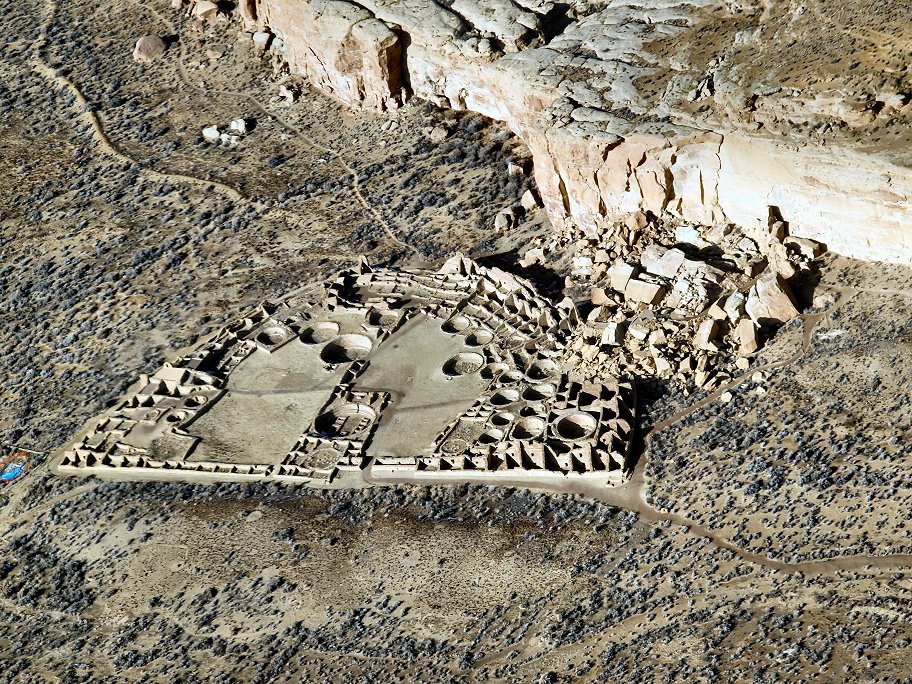 Aerial view of Pueblo Bonito.
More Canyon Highlights
Casa Rinconada Community was occupied from AD 1075 – 1250s and is considered a village rather than a great house. The village features the largest great kiva in the canyon.
 Casa Rinconada Community’s great kiva.
From wayside information: Unlike the monumental Chacoan great houses, the villages along this trail are more modest. Yet both the great houses and the villages were built and occupied during the same period. Hundreds of these small villages and communities have been discovered clustered around Chacoan great houses. The role of the great houses isn’t clear. Perhaps they served a central purpose: ceremonial, economic, and administrative, and the small village communities supported those efforts.
 Ruins of the Casa Rinconada Community.
Una Vida is another of Chaco Canyon’s great houses and was occupied from AD 850 – 1250s. Basically untouched, Una Vida has had little excavation.
 Ruins at Una Vida
According to archaeologists, Una Vida was two to three stories tall and had 100 ground floor rooms and kivas. Additional rooms surrounded the plaza. Interestingly, a jewelry workshop was found at Una Vida along with pottery from Mesa Verde which is now Mesa Verde National Park.
 Petroglyph panel at Una Vida.
Desert sand and vegetation preserve most of Una Vida and its great kiva, so it looks much like it did when it was discovered in 1849. Una Vida is reached via a 1-mile out and back trail that starts at the visitor center.
Wetherill Cemetery
A lonely patch of sandy scrubland is the final resting place of Richard Wetherill, his wife, Marietta, and several others.
 Wetherill Cemetery
Richard Wetherill was a Colorado rancher, but he had a passion for ancient puebloan culture and was an amateur archaeologist. He is credited with coining the word Anasazi to describe the ancient ones who occupied the ancestral pueblo dwellings of the southwestern US and is also credited with rediscovering and excavating some of the dwellings at what is now Mesa Verde National Park.
 Richard Wetherill
Wetherill established a homestead in Chaco Canyon where he assisted in excavating Pueblo Bonito under the auspices of the American Museum of Natural History. He ran a trading post in the canyon until his death. Click here to learn more about Mr. Wetherill and his mysterious murder.
Fajada Butte

Rising approximately 440 feet (135 meters) from the canyon floor, Fajada Butte is the predominant natural landmark in Chaco Canyon. It is also sacred to the Navajo, Hopi, and Pueblo peoples, and it is home to the most significant petroglyph in the canyon: the Sun Dagger.
According to the park: Atop Fajada Butte Chacoan skywatchers commemorated the movement of the sun and the seasons. Sunlight passed between three boulder slabs onto a spiral petroglyph to mark the sun’s position on summer solstice, winter solstice, and the equinoxes.
In recent years, scientists have noticed a change in the light pattern on the spiral due to slipping of the boulder slabs. They suspect that the slipping could be from human-caused erosion to the base of the rocks, and as a result access to Fajada Butte is prohibited.
See a photo of the Sun Dagger here.
Wildflowers
We were fortunate to visit Chaco Canyon when many wildflowers were blooming. We hope that we have identified them correctly. Click on any image in the gallery below to view as a slideshow.
 Wild Rubharb
  Narrowleaf Beardtongue
  Desert Plume
  Scarlet Globemallow
  King Cup Cactus
  Evening Primrose
  Wild Rubharb
  Easter Daisy
  Fleabane
  Fleabane
  Notch-leaved Phacelia
  Mormon Tea
Thank you so much for joining us on our Chaco Canyon road trip! We appreciate you more than we can express. We’re closing the post with one of the friends we made on our visit to the park.
 Common blotch-sided lizard
Want to see more in New Mexico? Check out these great destinations:
New Mexico’s Salinas Pueblo Missions
Pecos National Historical Park
Albuquerque to Taos Road Trip: Things to Do
Safe travels, y’all!
Mike and Kellye

As always, we strive to be as accurate with our information as possible. If we made a mistake, it was unintentional. (Hey, we’re only human!) Our opinions are our own.
©2023
Featured 
We covered Yellowstone National Park in a seven-part series several years ago. This is an enhanced and updated single post highlighting the sections of the magnificent park which is also UNESCO World Heritage Site.

Getting There
Our journey began by flying to Salt Lake City, Utah and renting a car for the road trip. The distance between Salt Lake City and West Yellowstone, Montana, which was our home base, is 320 miles/4.5 hours via I-15. We chose to break up the trip by spending our first night in Idaho Falls, Idaho.
⇒From Salt Lake City, take I-15 north toward Ogden, Utah. Continue north toward Pocatello, Idaho. Stay on I-15 to Idaho Falls.
Drive time between Salt Lake City and Idaho Falls is 3 hours through gorgeous scenery.
 Falls on the Snake River, Idaho Falls, Idaho
⇒From Idaho Falls, take US Highway 20 north toward Rexburg, Idaho. Continue north to West Yellowstone, Montana, which is the west entrance into the park. Drive time between Idaho Falls and West Yellowstone: 1.75 hours.
⇒Must-do stops in West Yellowstone include the Museum of the Yellowstone and the Grizzly and Wolf Discovery Center
Destination – Yellowstone National Park
The scenic Grand Loop Road through Yellowstone is laid out in a figure eight as shown on the map below. The highest speed limit we saw was 45 miles per hour, but that doesn’t mean much. When there are animal sightings, traffic stops. Bison jams are common, and visitors are at a standstill until the big beasts decide to move out of the way. Heavy traffic also slows travel, especially in the summer months.

Madison Area
 The Madison River meanders lazily past Mount Haynes
Trivia: the Madison is one of the three rivers that converge near Three Forks, Montana to form the headwaters of the Missouri River. The other two rivers are the Gallatin and the Jefferson.
 Gibbon Falls
  Steamy water and brilliant colors from the runoff of Blood Geyser in the Artists’ Paint Pots area of the park
Other points of interest in the Madison area of the park include:
- Terrace Springs
- Fountain Paint Pots
- Midway Geyser Basin
- Fairy Falls
- Firehole River
- Madison Information Station
Norris Area
The Norris Geyser Basin is the hottest area of Yellowstone National Park, in volcanic terms that is. Visitors will find geysers, hot springs, mud pots, steam vents, pools, and lakes at Norris. Steamboat Geyser, the largest geyser in the world, is also located here, though its eruptions are irregular and unpredictable. Hiking and walking trails are the best way to see everything this area has to offer.
 Porcelain Basin, Norris Geyser Basin
  Green and yellow thermophiles (hot water loving bacteria) create a spilled paint effect
Other points of interest at the Norris area of the park include:
- Norris Geyser Basin Museum
- Norris Bookstore
- Norris Campground
- Museum of the National Park Ranger
Canyon Village Area
The canyon village area is home to the Upper and Lower Falls of the Yellowstone River and the Grand Canyon of the Yellowstone. These are some of the most popular sights in the park.
 Grand Canyon of the Yellowstone
  Lower Falls
Trivia: Lower Falls is 308 feet tall, which is twice as high as Niagara Falls, and it is the highest waterfall in the park.
Points of interest in the Canyon Village Area include:
- Overlooks on North Rim Drive and South Rim Drive
- Uncle Tom’s Trail – 328 stairs to a Lower Falls viewpoint
- Canyon Lodge and restaurant
- Campground
Driving south from Canyon Village toward Lake Village and West Thumb Geyser Basin, visitors will pass through Hayden Valley. This area of the park is a great place to see wildlife and early mornings and evenings are best for sightings.
 The Yellowstone River meanders through Hayden Valley
Just past Hayden Valley is Mud Volcano and Dragon’s Mouth Spring. The area is super interesting and super sulphur-y! Take it from us, the intriguing sights will make you forget all about the smell.
 Mud Volcano’s pit of boiling mud of is difficult to see in this shot because of the steam
Some of the sights on the Mud Volcano Trail include Mud Cauldron, Mud Geyser, Sizzling Basin, Cooking Hillside, Black Dragon’s Cauldron, Grizzly Fumarole, and Sour Lake. All are aptly named, but don’t be afraid of the smells. This where Yellowstone shows off some of its best volcanic features.
 Dragon’s Mouth Spring. This spring not only spews steam and emits boiling water, but it also roars!
Six miles south of Mud Volcano is the Lake Village area which includes the Fishing Bridge, Visitor Center, Lake Yellowstone Hotel, and marina.
West Thumb Geyser Basin Area
The West Thumb Geyser Basin and Grant Village areas of the park are located approximately 28 miles/30 minutes southwest of the Lake Village area. Located on the banks of Yellowstone Lake, West Thumb, which is a small caldera, has some of the most colorful pool features of the park.
 Lots of shades of blue, and not a cloud in the sky – Yellowstone Lake
West Thumb features hiking/walking trails (boardwalk), a bookstore and information station, as well as a campground. Grant Village includes a hotel and visitor center.
 Bluebell Pool
  Black Pool
  Abyss Pool
Upper Geyser Basin Area and Old Faithful
This area of the park sits halfway between West Thumb and Madison and is the most popular section of the park.
 Old Faithful Geyser
While it is not the biggest or most frequently erupting geyser in Yellowstone National Park, Old Faithful is certainly the most popular. Visitors flock to the grandstand viewing area to watch it erupt, which it does about every 90 minutes.
 Built in 1904, the Old Faithful Inn is a National Historic Landmark
Things to do in the Upper Geyser Basin:
- Hiking/walking (boardwalk) trails
- Old Faithful Visitor Education Center
- Gift Shop
- Eat – there are five restaurants and/or grills in the area
- Biscuit Basin
- Black Sand Basin
- Morning Glory Pool
 The Upper Geyser Basin has over 150 hydrothermal features and approximately half of the geysers in the world!
Trivia: the chalky white substance around the geysers in Yellowstone is called geyserite.
Midway Geyser Basin Area
Grand Prismatic Spring, which is the third-largest hot spring in the world, is the star of the Midway Geyser Basin.
 Nature’s art. Up close view of the thermophiles – Grand Prismatic Spring
  Excelsior Geyser
Excelsior Geyser once spewed hot water hundreds of feet into the air, but it hasn’t erupted since the mid-1980s. Today 4,000 gallons of boiling water per minute pour from its crater into the Firehole River.
 Turquoise Pool can also be found in the Midway Geyser Basin
We are including Fountain Paint Pots as a sub-area of the park because we thought the area had some interesting sights, especially the geysers. The area is located between Midway Geyser Basin and Madison.
 Silex Spring
  Clepsydra Geyser erupts almost constantly
Trivia: a clepsydra is a water clock, and the name in the Greek language means water thief.
Mammoth Hot Springs Area
The springs in this area have created a series of travertine terraces. A boardwalk trail takes visitors through this amazing wonderland of minerals, water, and thermophiles.
 Minerva Terrace
  Palette Spring
  Rustic Falls can be seen from an overlook near Mammoth Hot Springs
Other highlights in the Mammoth Hot Springs area include:
- Historic Fort Yellowstone
- Albright Visitor Center – museum
- Mammoth Hot Springs Hotel
- Gardiner, Montana
- Heritage and Research Center (in Gardiner)
- Historic Roosevelt Arch at the North entrance to the park
Roosevelt-Tower Area
Note: As of 2022, parts of the north and northeast sections and entrances to the park may be closed due to flood damage. Check the website for information about road and trail closures.
The northern part of the park has rolling hills, meadows, and wildlife – what a thrill!

 Bison jam!
Trivia: Yellowstone’s bison were once on the verge of extinction due to unenforced hunting in the early years of the park. The current genetically pure (haven’t been bred with cattle) herd, which now numbers in the thousands, are descendants of the original twenty-four that were diligently preserved and carefully bred by the park.
 Calcite Springs and the Yellowstone River
  Columnar basalt decorates the cliffs overlooking the Yellowstone River.
  Tower Fall, 132 feet tall
The Roosevelt area of the park features Roosevelt Lodge and Cabins, a campground, and restaurant. A general store with fast food and a gas station can be found at Tower. The Tower Fall trailhead is next to the store.
Lamar Area
Unfortunately, we were unable to visit this section of the park. The Lamar Valley is reportedly one of the best viewing areas for wolves and other wildlife at Yellowstone. Located in the Northeast corner of the park near the Cooke City entrance, the scenic drive features mountains, the Lamar River, and trailheads for several trails. The drive from the northeast entrance to the Roosevelt-Tower area is 28 miles/1 hour.

Thank you for staying with us through this long post. Yellowstone is the one U.S. National Park that everyone should get to see at least once in their lifetime. And it’s the only one we want to revisit because once wasn’t enough for us! We are going to close the post with an up-close shot of one of the formations at Palette Spring.
 Travertine icicles drip from a ledge while tiny water droplets create dangling strings of pearls. The icy-looking landscape is enhanced by the cascading colors of the thermophiles.
Looking for more national park adventures? Click on these:
Death Valley National Park
Black Canyon of the Gunnison National Park
Bryce Canyon National Park
Travel safe, travel smart, and we will see you down the road!
Mike and Kellye

As always, we strive to be as accurate with our information as possible. If we made a mistake, it was unintentional. (Hey, we’re only human!) We aren’t paid for our recommendations, and we only recommend our own tried and true products, vendors, and venues. Our suggestions are for places that we’ve heard good things about but haven’t visited personally, and our opinions are our own. Photo copyright infringement is not intended. Our written content and photos are copyrighted and may not be published without our permission.
©2022
Featured 
The home of Thomas Jefferson, Monticello sits atop a hill on some of the 5,000 acres of land that he inherited from his father. Begun in 1768, it took Jefferson forty years to complete the house. This was partially due to his love of architecture and partially due to the fact that family members moved in and needed space. Our tour guide told us that Mr. Jefferson’s sister moved in with her eleven children during the years in which he was supposed to be enjoying retirement.
 Thomas Jefferson’s bed is tucked into an alcove between the actual bedroom and his office.
About 60 percent of the current contents of the home did belong to Jefferson, though some items have been lost, are in other museums, or in the hands of private collectors. We saw several of his inventions, including a two-sided clock that can be seen inside the house and above the door on the porch, a dumbwaiter hidden in the side of the dining room fireplace that goes to the wine cellar, and a contraption which held a second pen and copied everything as he wrote.
The property, along with the University of Virginia, is a UNESCO World Heritage Site. The university, which is just a few miles from Monticello, was established by Jefferson who also designed the original buildings. Construction began on the most famous building, The Rotunda, in 1822, and was completed just after Jefferson’s death in 1826.
 Sundial and view from the north terrace
  Another view from the north terrace: The Rotunda at the University of Virginia. Jefferson wanted to be able to see the university from his home. Now it is visible through a hole in the trees.
  The Rotunda, which was designed to be a library, at the University of Virginia up close with the symbols of the ultra secretive Seven Society and a statue of Thomas Jefferson
  The Rotunda from the lawn. The Palladian architecture looks very similar to Monticello, but was modeled after the Pantheon in Rome.
Monticello was also home to more than 100 enslaved laborers, including Jefferson’s half sister-in-law, Sally Hemings. It is now known that Jefferson fathered at least six of Hemings children, four of whom lived to adulthood. The story of Sally Hemings is fascinating, though little is known about her – not even what she looked like or where she is buried. What is known about her is detailed on the Monticello website here: https://www.monticello.org/sallyhemings/. There are also Amazon Video and Netflix documentaries about her and her ancestors for those who want to learn more. Notably, James Hemings, Sally’s older brother, was Jefferson’s chef at Monticello. James went to Paris with Jefferson while he was serving as Minister to France. James was trained in French cooking there and became a master chef. Sally arrived in Paris two years later while serving as Jefferson’s daughter’s companion and maid. Interestingly, slavery had been outlawed by then in France so legally James and Sally were free while they lived there.
 Another view of the house looking south
Mulberry Row, a community in itself, is where the laborers lived and worked at Monticello. Here the excavated remains of homes and several shops, such as ones where carpentry and blacksmithing among other crafts and trades took place, can be seen today. The lush flower and vegetable gardens that were once tended by enslaved people are still grown at Monticello along Mulberry Row. For more information on Mulberry Row click here: https://www.monticello.org/slavery/landscape-of-slavery-mulberry-row-at-monticello/.
Jefferson was penniless when he died on July 4, 1826. His heirs were tasked with selling off acreage, possessions (sadly this included slaves who were said to have represented 90 percent of his property) and eventually the grand house to pay the debts. Monticello passed through several owners before being purchased by the Thomas Jefferson Foundation in 1923.
Past Mulberry Row is a path that leads to Monticello’s cemetery where Thomas and Martha Jefferson are buried along with many members of their family. Though no known African-Americans are buried in the family cemetery at Monticello, archaeologists discovered an unmarked Jefferson-era slave cemetery in 2001. This discovery was important because it is known that 400 – 600 enslaved people worked and lived at Monticello, and until the cemetery was found nobody knew where they had been buried.
 Thomas Jefferson’s grave
We could go on for days about what we learned at Monticello, however, we have to end somewhere. In closing, we leave you with these final tidbits:
*Monticello had up to five bathrooms (privies), or air closets as Jefferson referred to them on his blueprints for the home. Historians know that the house did not have flush toilets, but not much else is known about the workings of them.
*Though Jefferson was representing the government as the Minister to France, all expenses involved with living and entertaining there were out of his own pocket.
*The Hemings family were inherited by Thomas and Martha Jefferson upon the death of Mrs. Jefferson’s (and Sally Hemings’) father, John Wayles.
*Sally Hemings quarters were discovered and excavated in 2017 then restored and opened to the public in 2018.
*Jefferson was only thirty-three-years-old when he was asked to write the Declaration of Independence. It only took seventeen days for him to compose the document and two days for the Second Continental Congress to make changes and declare independence on July 4, 1776. We never knew that any government got things done that quickly!
Finally, we highly recommend clicking on https://www.monticello.org/ to learn about the third President of the United States and his beloved home.
Thank you for hanging with us through this long post. We hope you will join us again soon for another great road trip. Until next time…
Travel safe, travel smart, and we will see you down the road!

As always, we strive to be as accurate with our information as possible. If we made a mistake, it was unintentional. (Hey, we’re only human!) We aren’t paid for our recommendations, and we only recommend our own tried and true vendors and venues. Our suggestions are for places that we’ve heard good things about but haven’t visited personally, and our opinions are our own.
©2021
Archives Select Month September 2023 August 2023 July 2023 June 2023 May 2023 April 2023 March 2023 February 2023 January 2023 December 2022 November 2022 October 2022 September 2022 August 2022 July 2022 June 2022 May 2022 April 2022 March 2022 February 2022 January 2022 December 2021 November 2021 October 2021 January 2021 May 2020 April 2020 March 2020 February 2020 January 2020 December 2019 November 2019 October 2019 September 2019 August 2019 July 2019 May 2019 April 2019 March 2019 February 2019 January 2019 December 2018 November 2018 October 2018 September 2018