
Petroglyphs Archives – One for the Money Two for the Road
Featured 
Chaco Canyon was a busy place 1,000 years ago. Early great houses (large public buildings) began being built around 800 AD, and construction continued for about 300 years. Today the ruins of the Chacoan great houses stand as a testament to their builders’ culture, brilliant architectural and astrological knowledge, and remarkable ability to thrive in the harsh conditions of the desert southwest. Enjoy your visit. 
Where is it?
Chaco Canyon lies in the Four Corners region of the US in northwestern New Mexico. (Four Corners is where the corners of the states of New Mexico, Arizona, Utah, and Colorado meet.) A town called Nageezi is the closest map dot to the park, but it doesn’t offer much more than a turn off for the road to the canyon, which involves another 24-mile trek, and part of the road is very bumpy gravel. But getting there is half the fun, right?
 On the (smooth) road to Chaco Canyon.
Besides being a national park unit, Chaco Culture National Historical Park is also a UNESCO World Heritage Site and a designated International Dark Sky Park. Features of the park include:
- Visitor center, museum, park film
- Bookstore/gift shop
- Nine-mile-long Canyon Loop Drive – open to motor vehicles and bicycles.
- Three additional bike trails.
- Four backcountry trails – permit required.
- Gallo Campground, featuring 32 individual and two group sites which can be reserved through www.recreation.gov. RV, tent, and car camping is available with some restrictions and no hook ups.
- Periodic night sky events, and the park also features an observatory.
- Periodic ranger led tours or talks.
- Seasonal hours apply.
- Admission fee applies.
Access the park’s website here.
 Chaco Canyon Visitor Center
Many Roads Led to Chaco Canyon
Chaco Canyon was a regional center for trade, and an elaborate road system covering hundreds of miles connected the area’s great houses. The map below shows the great houses and the roads.  Chaco Culture National Historical Park, formerly Chaco Canyon National Monument, protects the 16 great houses in and around the canyon. The park’s great houses are the best preserved prehistoric architectural structures in North America. Additionally, archaeological and anthropological studies of the site have resulted in the discovery of over 1.5 million artifacts, most of which are in the care of the University of New Mexico in Albuquerque.
 A glimpse inside the park’s museum.
The new Chaco Canyon Visitor Center and museum opened in 2017 after years of planning and construction. Artifacts from the park’s collection as well as some borrowed from other museums were to be displayed in the park’s museum. Unfortunately, the heating and air conditioning system does not provide the proper climate controls needed to preserve the artifacts. Now, several years later with no resolution to the climate control issues in sight, empty display cases line the walls of the museum.
 Some of the display cases feature reproduction pottery such as the jar shown above.
Despite the fact that the museum didn’t have original artifacts, it did provide us with a lot of interesting information about the canyon, its inhabitants, and the great houses.
The Great Houses
Builders of the great houses quarried stone and carried timber from many miles away. They also constructed dams, waterways, and stairways. Chaco Canyon’s great houses are sacred to many Native American tribes.
Hungo Pavi was occupied from AD 1000 – 1250s and remains unexcavated.
 Hungo Pavi
Chetro Ketl is the second largest great house in Chaco Canyon and was occupied from AD 950 – 1250s. With 400 rooms, it covers 5.5 acres (2.3 hectares) which actually makes it the largest in terms of surface area.
 Chetro Ketl practically blends into its surroundings.
  Chetro Ketl’s back wall.
  Petroglyphs on the mesa wall between Chetro Ketl and its closest neighbor Pueblo Bonito.
Pueblo Del Arroyo was occupied from AD 1075 – 1250s. Unlike other Chacoan great houses, Pueblo Del Arroyo does not have a great kiva (communal meeting place or possible ritual site). Perhaps its people shared Pueblo Bonito’s great kivas, as the two great houses sit just a few hundred yards apart.
 Pueblo Del Arroyo
  Archaeologists who excavated Pueblo Del Arroyo in the mid 1920s uncovered only about half of the great house.
Pueblo Bonito
The largest of all great houses, was occupied from AD 850 – 1250s and was the first Chacoan great house to be excavated.
 Pueblo Bonito as seen from the trail.
Archaeologists believe that Pueblo Bonito was the convergence point of the roads leading to Chaco Canyon. The four story, D-shaped structure featured about 800 rooms, 32 kivas, and four great kivas. Its number of occupants remains debatable due to the lack of trash piles and burial sites. Some theorize that the huge great house was used primarily as a ritual site, thus the four great kivas.

In 1941, 30,000 tons of rock slid off of the mesa’s face and destroyed about 30 of the pueblo’s rooms. The Chacoan builders of the great house knew a rockslide was possible and had built supporting masonry walls just in case. Remarkably, Threatening Rock as it was called, held stable for centuries before it finally gave way.
 View of the pueblo and the rockslide.
  It is hard to tell how big the pueblo is from ground level.
For size and scale purposes, the aerial photo below shows the great house and the rockslide debris. Credit for the photo goes to Bob Adams of Albuquerque, New Mexico via Wikipedia.
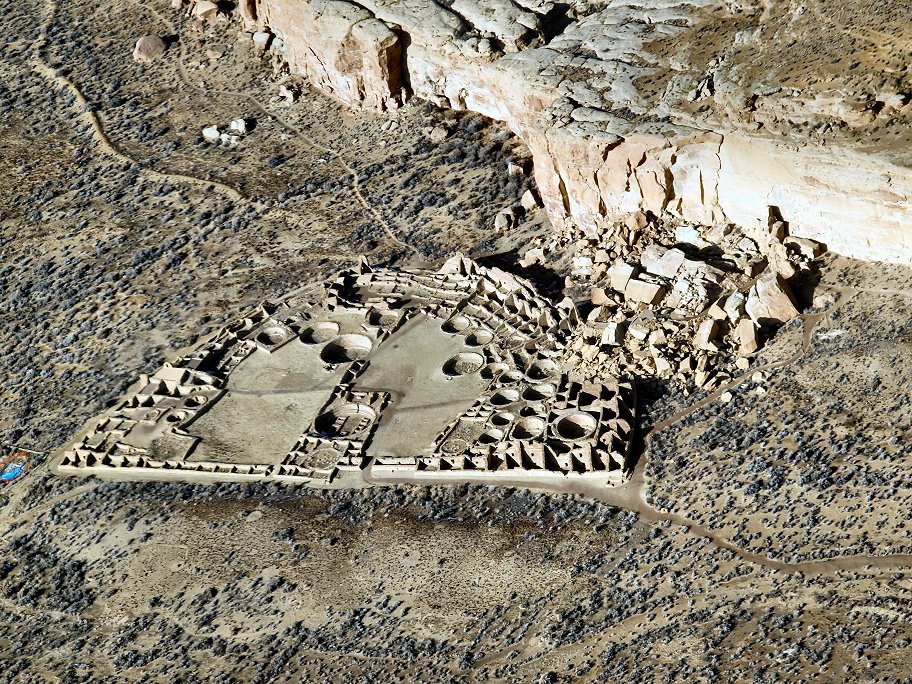 Aerial view of Pueblo Bonito.
More Canyon Highlights
Casa Rinconada Community was occupied from AD 1075 – 1250s and is considered a village rather than a great house. The village features the largest great kiva in the canyon.
 Casa Rinconada Community’s great kiva.
From wayside information: Unlike the monumental Chacoan great houses, the villages along this trail are more modest. Yet both the great houses and the villages were built and occupied during the same period. Hundreds of these small villages and communities have been discovered clustered around Chacoan great houses. The role of the great houses isn’t clear. Perhaps they served a central purpose: ceremonial, economic, and administrative, and the small village communities supported those efforts.
 Ruins of the Casa Rinconada Community.
Una Vida is another of Chaco Canyon’s great houses and was occupied from AD 850 – 1250s. Basically untouched, Una Vida has had little excavation.
 Ruins at Una Vida
According to archaeologists, Una Vida was two to three stories tall and had 100 ground floor rooms and kivas. Additional rooms surrounded the plaza. Interestingly, a jewelry workshop was found at Una Vida along with pottery from Mesa Verde which is now Mesa Verde National Park.
 Petroglyph panel at Una Vida.
Desert sand and vegetation preserve most of Una Vida and its great kiva, so it looks much like it did when it was discovered in 1849. Una Vida is reached via a 1-mile out and back trail that starts at the visitor center.
Wetherill Cemetery
A lonely patch of sandy scrubland is the final resting place of Richard Wetherill, his wife, Marietta, and several others.
 Wetherill Cemetery
Richard Wetherill was a Colorado rancher, but he had a passion for ancient puebloan culture and was an amateur archaeologist. He is credited with coining the word Anasazi to describe the ancient ones who occupied the ancestral pueblo dwellings of the southwestern US and is also credited with rediscovering and excavating some of the dwellings at what is now Mesa Verde National Park.
 Richard Wetherill
Wetherill established a homestead in Chaco Canyon where he assisted in excavating Pueblo Bonito under the auspices of the American Museum of Natural History. He ran a trading post in the canyon until his death. Click here to learn more about Mr. Wetherill and his mysterious murder.
Fajada Butte

Rising approximately 440 feet (135 meters) from the canyon floor, Fajada Butte is the predominant natural landmark in Chaco Canyon. It is also sacred to the Navajo, Hopi, and Pueblo peoples, and it is home to the most significant petroglyph in the canyon: the Sun Dagger.
According to the park: Atop Fajada Butte Chacoan skywatchers commemorated the movement of the sun and the seasons. Sunlight passed between three boulder slabs onto a spiral petroglyph to mark the sun’s position on summer solstice, winter solstice, and the equinoxes.
In recent years, scientists have noticed a change in the light pattern on the spiral due to slipping of the boulder slabs. They suspect that the slipping could be from human-caused erosion to the base of the rocks, and as a result access to Fajada Butte is prohibited.
See a photo of the Sun Dagger here.
Wildflowers
We were fortunate to visit Chaco Canyon when many wildflowers were blooming. We hope that we have identified them correctly. Click on any image in the gallery below to view as a slideshow.
 Wild Rubharb
  Narrowleaf Beardtongue
  Desert Plume
  Scarlet Globemallow
  King Cup Cactus
  Evening Primrose
  Wild Rubharb
  Easter Daisy
  Fleabane
  Fleabane
  Notch-leaved Phacelia
  Mormon Tea
Thank you so much for joining us on our Chaco Canyon road trip! We appreciate you more than we can express. We’re closing the post with one of the friends we made on our visit to the park.
 Common blotch-sided lizard
Want to see more in New Mexico? Check out these great destinations:
New Mexico’s Salinas Pueblo Missions
Pecos National Historical Park
Albuquerque to Taos Road Trip: Things to Do
Safe travels, y’all!
Mike and Kellye

As always, we strive to be as accurate with our information as possible. If we made a mistake, it was unintentional. (Hey, we’re only human!) Our opinions are our own.
©2023
Featured 
Welcome to a place where the only trees in sight are petrified! We first visited Petrified Forest National Park in 2008. At the time we were in a hurry to reach another destination and unfortunately did not make the most of our visit. This time we made the most of our visit by walking most of the trails, learning more, and hopefully making better photographs. We hope you enjoy touring the park with us. 
Where is it?
Petrified Forest National Park is located between I-40 and Highway 180, near Holbrook, Arizona. Access the park’s website here.
 The Painted Desert Inn, which is a National Historic Landmark, can be found on the portion of Historic Route 66 that traverses the park. The former inn now serves as a museum.
What you should know before you go:
- Admission fees apply.
- The 28-mile-long park road is open from 8:00 am to 5:00 pm, as are the Rainbow Forest and Painted Desert Visitor Centers.
- The Painted Desert Inn National Historic Landmark is open from 9:00 am to 4:00 pm.
- A park film can be viewed in either of the two visitor centers.

- There are parking areas, trails, and/or overlooks at all the main attractions in the park.
- Pets are allowed in the park as long as they are leashed. Horses are allowed in designated wilderness areas.
- A diner and convenience store with gasoline are located next to the Painted Desert Visitor Center. There are also several picnic areas with restrooms throughout the park.

- There are no campgrounds in the park. However, backcountry camping is allowed in designated wilderness areas of park, and a permit is required.
- Park sponsored demonstrations, guided activities, and workshops take place throughout the year.
 It’s hard to believe this was once a rainforest and riparian ecosystem.
Rainbow Forest Museum
Our first stop was at the Rainbow Forest Museum and visitor center where we learned about the prehistoric history of the park. Once part of the super continent called Pangea about 220 million years ago, what is now Petrified Forest National Park was about 10 degrees north of the equator.  As a rainforest surrounded by rivers and swamplands, its inhabitants included intriguing pre-dinosaur age animals that roamed or swam in the area.
 Placerias hesternus lived before and then with the dinosaurs.
Displays in the museum featured several interesting animals including the placerias hesternus. According to museum information: Placerias hesternus (plu-SAYR-ee-us hess- TERN-us) was a dicynodont therapsid. Therapsids were large “reptiles” that possessed many mammalian characteristics including a “cheek” bone, enlarged canine teeth, and a specialized attachment of the skull to the spine. This massive plant-eater was up to 9 feet (2.7 m) long and might have weighed as much as two tons.
 Artist’s rendition of what the animal might have looked like.
Interestingly, a large number of placerias hesternus fossils were found in a quarry in St. Johns, Arizona, a town southeast of the park.
Giant Logs Trail
Giant Logs Trail located behind the Rainbow Forest Visitor Center lives up to its name. Below are a few photos of the colorful petrified tree trunks along the trail. 


Crystal Forest
Believe it or not, the logs in Crystal Forest had become crystalline quartz before T. rex arrived 135 million years later!
 Crystal Forest
According to the park, this area was once on the edge of a river channel. Flooding over time caused the trees to become buried under silt which preserved them. Gradually the volcanic silica in the groundwater replaced the molecules in the wood and created a replica of the tree or log in quartz.
 Littered with logs.
  Spectacular colors.
Blue Mesa
The Blue Mesa area of the park was probably the most intriguing to us because of the incredible geology. We didn’t caption the photos below because words really can’t describe the beauty of the place. 

 According to the park: The colorful bands of the Chinle Formation represent ancient soil horizons. While the red, blue, and green layers generally contain the same amount of iron and manganese, differences in color depend on the position of the groundwater table when the ancient soils were formed. In soils where the water table was high, a reducing environment existed due to a lack of oxygen in the sediments, giving the iron minerals in the soil a greenish or bluish hue, such as at Blue Mesa. The pink and reddish layers were formed where the water table fluctuated, allowing the iron mineral to oxidize (rust).
 That’s a little bit of snow in the left foreground.
The Tepees
Blue Mesa isn’t the only area of the park with breathtaking terrain. Introducing the Tepees.
 The Tepees
According to the park: The Tepees are located in the middle of the park, but expose one of the lowest, thus oldest, rock members within the park and the Painted Desert.
 View across the road from The Tepees. Oh, those colors, and we accidentally captured the moon!
Newspaper Rock
Newspaper Rock is not just one rock. Throughout the area are many rocks with petroglyphs and other writings. Visitors view the rocks through telescopes/binoculars at the viewpoint – or in our case by zooming in with the camera. Most of the rock below is covered with petroglyphs that are thought to date back 600 – 2,000 years.
 Petroglyphs
Puerco Pueblo
Petrified Forest National Park protects the ruins of a village that was once a 100-room pueblo and home to about 200 people. Puerco Pueblo’s residents were farmers who grew beans, corn, and squash while utilizing the nearby Puerco River for irrigation. Scientists believe the site was abandoned by 1380 due to climate change and severe drought conditions.
 Some of the pueblo ruins.
  One of several kivas (underground ceremonial rooms) located on the site.
Painted Desert
Named by Spanish explorer Francisco Vasquez de Coronado, the Painted Desert actually stretches about 150 miles from the eastern side of the Grand Canyon southeast to Petrified Forest National Park. Visitors traveling the portion of Historic Route 66 through Petrified Forest can see even more of the park’s breathtaking landscapes from several viewpoints along the way. Gorgeous desert vistas can also be seen from the Painted Desert Visitor Center.
 Stunning vista.
  Pretty in pink.
While we have barely scratched the surface of Petrified Forest National Park, we hope we have inspired some wanderlust. This is one of those parks that cannot be justified by photographs and words; it needs to be seen in person to be appreciated for its beauty and historic importance. We thank you so much for joining us on our road trip!  Need more national park inspiration? Try these other great parks:
Happy, safe travels, y’all!
Mike and Kellye

As always, we strive to be as accurate with our information as possible. If we made a mistake, it was unintentional. (Hey, we’re only human!) Our suggestions are for places that we’ve heard good things about but haven’t visited personally, and our opinions are our own.
©2023
Featured 
Saguaro (pronounced suh-war-o) National Park is a landscape unlike any other we’ve seen. A literal cactus forest divided into two units – the Rincon Mountain District (east) and the Tucson Mountain District (west) – and it is approximately 30 miles between the two.  We visited the east unit on a day when a cold front was blowing in and it was very windy. On the next day when we visited the west unit, we woke up to snow which thankfully disappeared quickly as the day warmed up. Both units were great, but if we had to choose only one, we would probably choose the west unit.
 View of the Rincon Mountains from the east unit.
We are excited to share this park with you and hope you enjoy learning about it through our words and lenses.
Where is it?
Saguaro National Park is located in the Sonoran Desert near Tucson, Arizona. The east unit is located at 3693 S. Old Spanish Trail, Tucson, Arizona. The west unit is located at 2700 N. Kinney Road, Tucson, Arizona.
 Along Cactus Forest Drive (scenic drive) at the east unit.
The park features:
- Visitor centers at each unit with exhibits, park films, and cactus gardens
- Bookstores at each unit’s visitor center
- Hiking trails at each unit
- Bicycling trails at each unit
- Horseback riding allowed on trails at the east unit
- Backcountry camping with permit
- Picnic areas at each unit
- Scenic drives at each unit
- Ranger-led programs
- Entry fee covers both units
Access the park’s website here.
 The two saguaros in the center look like they’re high fiving each other. This view is from the Bajada Loop Drive (scenic drive) at the west unit.
The Sonoran Desert
 Map credit: Cephas, Wikimedia Commons.
Spanning 120,000 square miles, the Sonoran Desert covers parts of Arizona and California as well as parts of Mexico. Neighbors include the Chihuahuan Desert to the East, the Mojave Desert to the north, and the Great Basin Desert to the northwest, with each desert possessing different distinguishing factors and its own diverse ecosystems.

The Sonoran Desert’s subtropical climate is characterized by its mild winters and hot summers. It is the hottest desert in North America. Rainfall varies from 3-16 inches per year, though some higher elevation areas receive more rain along with snow in the winter. The desert’s monsoon season usually runs from July through September.
 Saguaros only grow in the Sonoran Desert.
This desert is home to over 2,000 species of plants. Organ pipe cactus is another species that only grows in the Sonoran Desert and can be found at Organ Pipe Cactus National Monument in the southwest corner of Arizona.
Desert Cacti
While the saguaros are the stars of the show at Saguaro National Park, we enjoyed learning about some of the other cactus varieties that make their home in the Sonoran Desert.
 Teddy bear cholla
Our newest cactus discovery was the teddy bear cholla (pronounced choy-uh). We have a lot a cholla around where we live, but not this species. Even though the teddy bear cholla looks soft and cuddly, it is not!
 Fishhook barrel cactus
If we had visited the park in September rather than in March, we probably would have seen the fishhook barrel cactus in bloom. The interesting thing about this cactus is that it leans toward its greatest source of light. By doing this, the larger plants can topple over and uproot themselves.
 Chain fruit cholla
We never knew that there were so many species of cholla. We also saw staghorn cholla and pencil cholla. The one above is called a chain fruit cholla because it produces grapelike clusters of edible fruit. It is sometimes known as the jumping cholla due to its short, jointed stems that can easily drop from the plant and attach to people or animals that may be passing by.
Desert Trees
 Palo verde tree
Palo Verde means green stick in Spanish. Identifiable by their green bark, these interesting trees are found throughout the Sonoran Desert. Three things that make this tree so unique:
- It only has leaves/blooms during the spring, dropping them as temperatures climb in order to prevent water loss.
- It lives on virtually no water for prolonged periods of time.
- It survives by photosynthesis through its bark.
 Creosote bush
We were first introduced to creosote bushes at Big Bend National Park, and it’s likely that we only paid attention to them then because they smell so good – especially after a rain. Nevertheless, the unique thing about creosote bushes in the Sonoran Desert is that they, along with palo verde trees, mesquite trees, and other cacti species, are nurse plants for the saguaro. That means that baby saguaros grow underneath these nurse plants using their shade and nutrients to help the saguaro mature. As the saguaro grows, it takes all of the nurse plant’s nutrients and water which eventually kills the nurse.
The Saguaro
 Perfect saguaro?
While we walked trails and drove through Saguaro National Park, we spent a lot of time looking for a perfect saguaro. The fact is, there are few that epitomize what we thought a saguaro should look like. First of all, many of them have holes where desert dwelling birds have built homes. (But with no trees, what’s a bird to do?) Secondly, some saguaros have been affected by cold weather or old age, and they’re just not pretty anymore – at least they didn’t look pretty to us. Fortunately, we found a few perfect ones to share.  Here are some interesting facts about saguaros:
- Without knowing when it was planted there is no way to tell the age of a saguaro.
- Saguaros grow about one inch in its first 5 – 10 years.
- A saguaro may reach 6 feet tall by the time it is 35 – 60 years old and will flower for the first time around 55 years old.
- At 50 – 75 years old the saguaro will start to grow arms and may reach a height of 8 – 20 feet tall.
- While they are considered mature at 125 years old, saguaros can live between 150 – 200 years, and some may live up to 250 years.
- Pleats on the body of the saguaro allow them to expand to retain water, and the number of pleats matches number of wooden ribs on the inside of the plant.
- A fully grown saguaro can weigh up to 4 tons.
- Saguaros bloom for only 24 hours then the blossoms grow into fruit which is edible.
- Saguaro blossoms are the state flower of Arizona.
 Snow tipped saguaros – west unit.
Crested Saguaros
 Rare crested saguaro
Crested, or cristate, saguaros are rare, and while some biologists believe that the crests are caused by genetic or hormonal reasons, others think there is a physical cause, such as a lightning strike or cold snap, for the fan-like formations. The fact is that nobody really knows for sure what causes the mutations. When we found out about them, we added them to our mission to find a perfect one, but the one pictured was the only one we found in either unit. According to a ranger, only 25 crested saguaros have been found among the 2 million saguaros living in the park.  The Crested Saguaro Society has catalogued about 3,300 of these unusual cacti throughout the Sonoran Desert region. Information about their finds is kept in a secret database so that vandals and poachers cannot locate the unique specimens.
It’s Not All About Cactus
Arizona and its surrounding states have been home to indigenous people for thousands of years. Clues to their existence have been left behind in cliff dwellings and other archaeological sites, implements, pottery, and rock art. Rock art can be painted (pictographs) or carved into the rock (petroglyphs). Saguaro National Park has a fine collection of about 200 petroglyphs at a site called Signal Hill.
 Some of Signal Hill’s petroglyphs
Hohokam (pronounced hoho-kahm) people, who lived in the area between 450 AD and 1450 AD created Saguaro National Park’s petroglyphs. How do we know this? Some of the same designs are seen in their pottery. Nobody really knows what the symbols mean, though there are speculations.


According to park information, some researchers believe that the petroglyphs are religious symbols. Others believe they may commemorate an event, mark a solstice, or even tell a story. We like to think that the ancient people were recording what they saw – similar to today’s photographs. Regardless of what they mean, it is fun to view them and try to make our own interpretations.
We are going to close the post with a few more shots from around the park.
 East unit trail view of pretty saguaros and other plants.
  West unit view from Signal Hill.
  Even though it was technically still winter, we saw wildflowers. Desert marigold, perhaps? Unfortunately, we missed a desert super bloom by about two weeks.
Thank you so much for exploring Saguaro National Park with us! If you love national parks or need more road trip ideas, check out these other great parks:
Grand Canyon National Park
Guadalupe Mountains National Park
Rocky Mountain National Park
Happy, safe travels, y’all!
Mike and Kellye
As always, we strive to be as accurate with our information as possible. If we made a mistake, it was unintentional. (Hey, we’re only human!) Our suggestions are for places that we’ve heard good things about but haven’t visited personally, and our opinions are our own.
©2023

- Website: Capitol Reef National Park.
- Accommodations in the park: RV and tent camping. Backcountry camping allowed with a permit.
- Great park for hiking, biking, and climbing.
- Lodging, additional camping, and groceries available in Torrey, Utah – 11 miles west of the west park entrance.
- Restaurants available in Torrey.
- When to go to Capitol Reef: Anytime. We recommend May or September.
The interesting terrain at Capitol Reef National Park was created by a 90-mile long wrinkle in the earth called a waterpocket fold. The picture below was taken from a high point on Highway 12 looking toward Capitol Reef (mid-background).

Getting There
⇒From Bryce Canyon National Park, take Highway 12 (recommended scenic route through Grand Staircase-Escalante National Monument) east toward Escalante, Utah, then north to Highway 24 through Torrey, Utah to the park’s entrance.
Travel tip: use extreme caution on Highway 12 through Grand Staircase-Escalante National Monument. There are twists, turns, and high points on the two lane road with no guardrails in some places, however, the scenery is spectacular and very worth taking the route. Drive time between Bryce Canyon and Capitol Reef: 2.5 hours, or,
⇒From Salt Lake City (closest major airport city), take I-15 south to Scipio, Utah. At Scipio, take US Highway 50 to US Highway 89 to Richfield, Utah then Highway 24 south(east) through Torrey, Utah and the park’s entrance. Drive time between Salt Lake City and Capitol Reef National Park: 3.5 hours.
Travel tip: if you are continuing on to Moab, Utah, top off your gas tank in Torrey before entering the park. The closest gas station (in Hanksville) is an hour east.
Destination: Capitol Reef National Park

Stop in at the visitor center for information about the park. Then continue on Highway 24 to Fruita, Utah, which is the site of an old settlement that is now contained inside the park. Did you know that the original orchards planted by settlers in this area remain in Capital Reef today? The orchards are open to the public during the picking seasons. Check the park’s website for details about how and when the fruits can be harvested.
At Fruita, stop in at the Gifford House Museum and Store, check out the Fruita Schoolhouse, and don’t forget to take a few pictures of the Gifford Barn; it’s a classic!
The Fruita historic area is a great place for a leisurely stroll and a picnic. There is a campground here, too.
 Gifford Barn

Take Scenic Drive south of Fruita for scenery and views of the waterpocket fold, or continue on Highway 24 east through the park. There are several places to pull out. We enjoyed seeing the petroglyphs. Parking is available in this area and there are easy trails/boardwalk to allow ample viewing of these ancient wonders.
Of course, the scenery is what we went to Capitol Reef to see, and it didn’t disappoint. Below are some of our favorite shots.

We are quite fond of red rocks, and no, they never get old!
 Interesting Formations and Beautiful Colors
This park is where we first learned about desert varnish. The “varnish”, from minerals and metals in the rock turns the rock into a work of art. Isn’t nature amazing?

This cliff face looks painted, but it’s not. It is just that pretty, although, the photo does not do justice to the actual view. The petroglyphs pictured above were high up on this wall.
 Travel tip: Capitol Reef has miles and miles of hiking trails for day hikers of all skill levels. There are also many options for backcountry hiking and backpacking. Just remember that this is the desert, and it can get extremely hot during the day. Take more water than you think you will need.
 We hope you enjoyed our short overview of Capitol Reef National Park. Unfortunately, it doesn’t get as much traffic or publicity as some of the other Utah national parks, but a short or long visit to Capitol Reef will be well worth your time. Leave a comment below and tell us about your trip. We love hearing from you. Until next time…
Travel safe, travel smart, and we will see you down the road.
Mike and Kellye

As always, we strive to be as accurate with our information as possible. If we made a mistake, it was unintentional. (Hey, we’re only human!) We aren’t paid for our recommendations, and we only recommend our own tried and true vendors and venues. Our suggestions are for places that we’ve heard good things about but haven’t visited personally, and our opinions are our own.
©2018
Archives Select Month September 2023 August 2023 July 2023 June 2023 May 2023 April 2023 March 2023 February 2023 January 2023 December 2022 November 2022 October 2022 September 2022 August 2022 July 2022 June 2022 May 2022 April 2022 March 2022 February 2022 January 2022 December 2021 November 2021 October 2021 January 2021 May 2020 April 2020 March 2020 February 2020 January 2020 December 2019 November 2019 October 2019 September 2019 August 2019 July 2019 May 2019 April 2019 March 2019 February 2019 January 2019 December 2018 November 2018 October 2018 September 2018